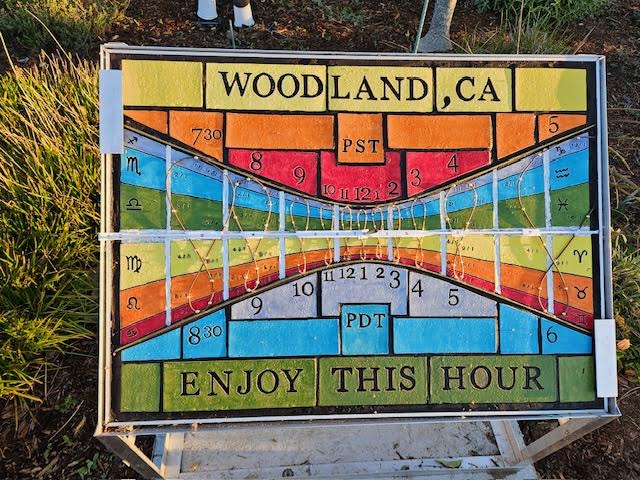
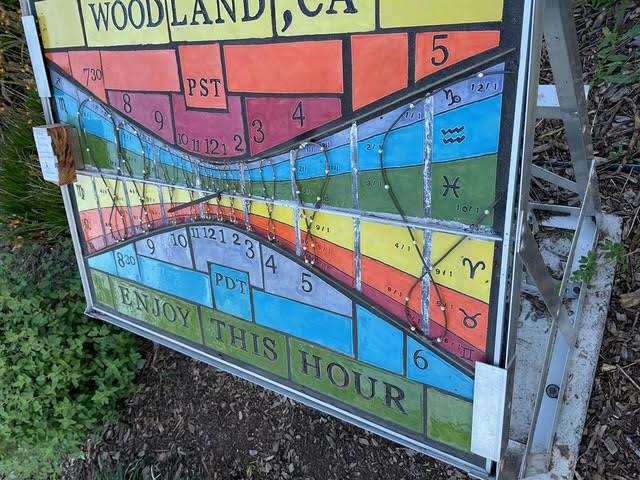
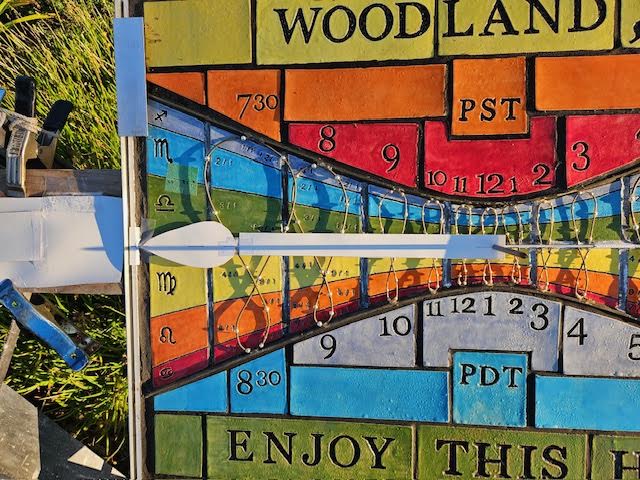
The March 2026 Equinox was met with tremendous anticipation at the home of the Woodland Polar Sundial. The Equinox is the great equalizer for our planet, since sunrise occurs almost due east and sunset almost due west, and the shadow of the tip of any perpendicular pole will track along a straight line throughout the day on any point on Earth, except the poles. A polar sundial does all this, but the shadow of the gnomon also tracks a line due west to due east that bisects the dial face , showing the beautiful symmetry and cycle of our annual trip around the sun.
The Equinoxes are always a treat to watch, but in 2026 the March Equinox occurred at 7:45:02 AM PDT, just 35 minutes after sunrise, 7:10 AM. This assured very long shadows at the moment the center of the sun crosses the plane of the celestial equator. A large tree east of the dial mostly blocks eastern light, but there is a gap that allowed direct sunlight from 7:37 AM to 8:10 AM. This seemed providential and I thought it would be a fun challenge to capture the shadow at 7:45 AM. This would be an exercise in low-altitude precision sundialing, where rapidly changing shadows and the geometrical optics effects which cause the penumbral shadow have to be considered.
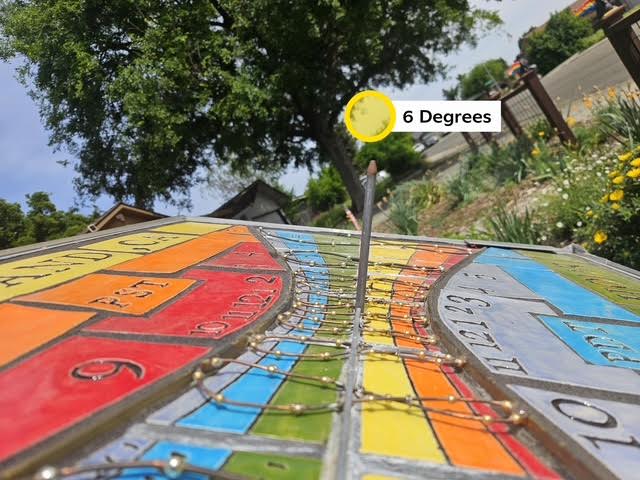
I calculated that, from 3/18/26 to 3/20/26, 35 minutes after sunrise, the local altitude of the sun would be between 5.97° and 6.13°. It would just edge slightly further north each day, allowing me to be sure the dial would receive full sunlight.
For example: Woodland Polar Sundial (WPS) 38.6564 N 121.7901 W
Solar Noon 3/20/2026 = 13:15:25 PDT = 13.24 hr H = Hour angle θ = latitude
7:45 AM = 7.75 hr Hours from solar noon = 7.75. – 13.24 = – 5.49 hr x 15°/hr = – 82.35° = H
α = altitude : sin α = (cos θ)(cos H) = (.7809)(.1331) = 0.103954
α = 0.10414 Radian = 5.96 ° local altitude from horizon
But a polar dial is mounted at an angle equal to its latitude, 38.656 ° from horizontal, for Woodland. It is thus parallel to the axis of the earth, and perpendicular to the celestial equator; it is the same as a horizontal dial on the equator. If the dial were moved directly south to the equator, but at the same longitude, solar noon would be the same, the 7:45 AM hour angle would be the same, but sunrise and sunset would be different, making the effective altitude different:
Dial on Equator 00.00 Latitude 121.7901 W. Solar Noon 3/20/26 = 13.24 hr
7:45 AM = 7.75 hr H = -82.35°
Sin α = (cos θ)(cos H) = (1)(.1331) = .1331 α = .13350 Radian = 7.65°
Although the sun rises close to a 90° azimuth angle (due east) on the Equinox in Woodland, by 7:45 AM , the sun has traveled further:
β = Azimuth Angle = cos¯¹ ( (sin δ cos θ- cosδ sin θ cos H) ÷ cos α δ = declination
For Woodland at 7:45 AM 3/20/26 :
β = cos¯¹ ( sin 0° cos 38.6564 – cos 0° sin 38.6564 cos -82..35) ÷ cos 5.956°
β = cos¯¹ ((0)(.7809) – (1)(.6247)(.1331) ∻ .9946 = cos¯¹ (-.0836)
β = 1.6548 Radians = 94.77°
A polar dial has an effective latitude of 0° , so
β = cos¯¹ ( sin 0° cos 0° – cos 0° sin 0° cos -82.35° ∻ cos 7.65°) ÷ cos 7.65°
β = cos¯¹ ( 0 – 0 )/.9911 = cos¯¹ (0) = 1.5708 Radians = 90.0002°
So, in Woodland, at 7:45 AM, even though the sun is at local azimuth angle 94.77°, the shadow of the dial is truly due west, as if the sun’s azimuth angle was 90°.
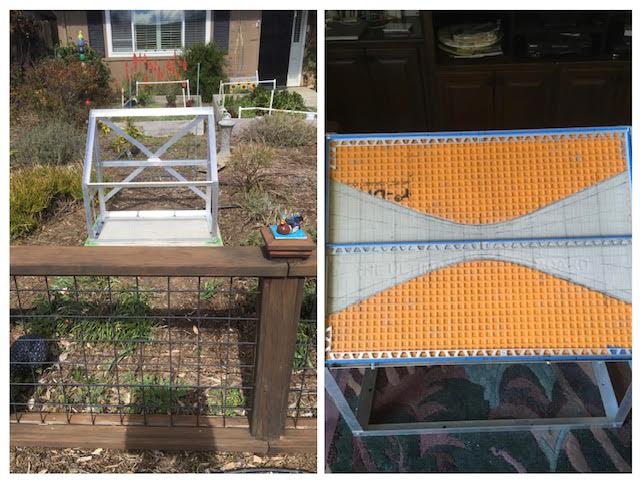
For my 106 mm gnomon, the calculated shadow, L, at 7:45:02 AM, would be tan α = 106/L; L = 789 mm., having established the altitude, α, as 7.65°. The dial face ends 450 mm from the gnomon, so the shadow would be far off the dial face to the west. To see the shadow , the gnomon height will have to be shortened. Putting a block on the dial face would accomplish this.
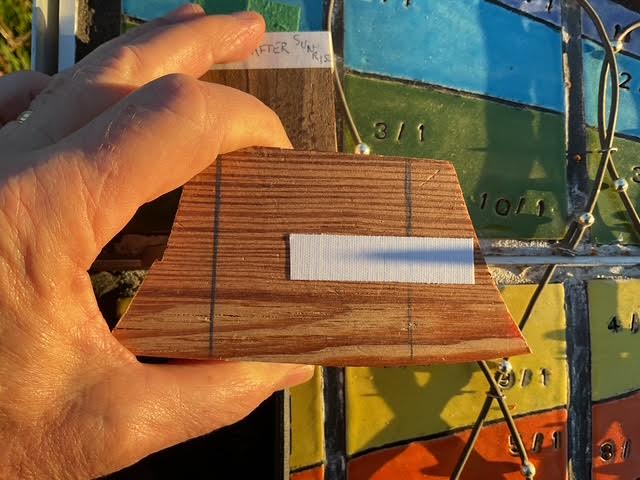
Because of the raised copper analemmas on the face of the dial, the only flat surface for the block was limited to a space between 365 mm to 450 mm west of the gnomon. I scrounged around and found two wooden blocks and guesstimated that a block height of 58.2 mm, reducing the gnomon height to 47.8 mm, would be enough.
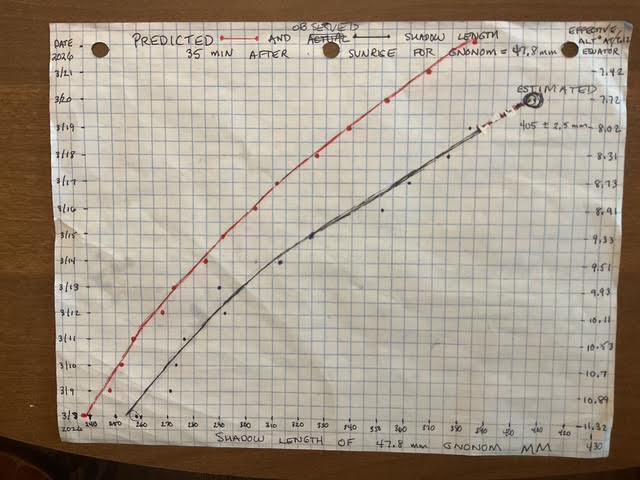
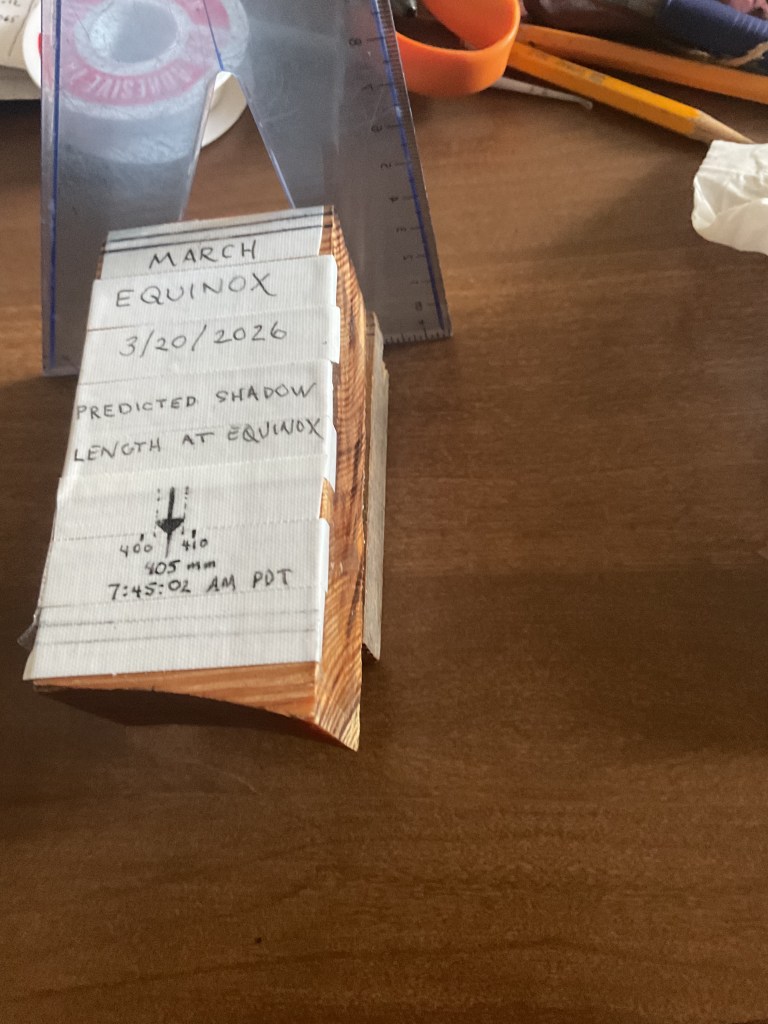
Starting on 3/8/26, I calculated the “effective equatorial altitude” as above and determined the predicted shadow length for a 47.8 mm gnomon until 3/22/26; this is the red line on the graph below. The altitude decreased from 11.32° on 3/8/26 to 7.72° on 3/20/26 ( I used Suncal.org to determine these which is why there is discrepancy from above 7.65° value). Each day from 3/8/26 to 3/19/26 ( all incredibly cloudless horizons), at 35 minutes after sunrise, I measured the observed shadow on top of the block . This is the black line. At these extremely low altitudes, slight time/altitude changes , not to mention small misalignments of the dial’s correct position, resulting in in large shadow changes, so , not surprisingly, there was more deviation from predicted as altitude decreased. On 3/19/26, I extended the observed shadow length line onto 3/20/26, to arrive at a predicted shadow length of 405 ∓ 2.5 mm. I then marked out where the block would go on the dial face so the 405 mm arrow would be 405 mm from the gnomon.
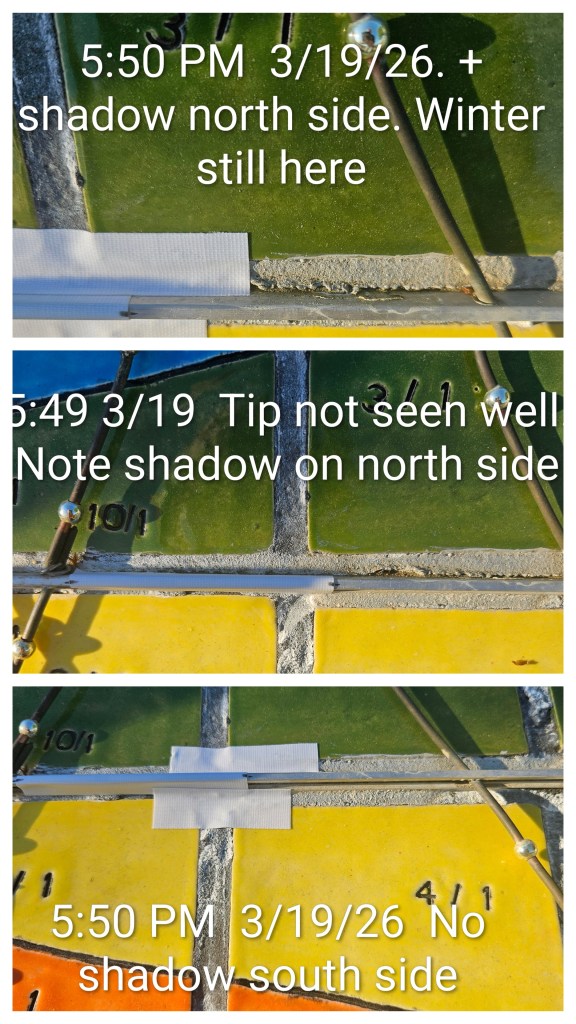
There is a small tree to the west so the last sunlight the dial received was about 5:50 PM on 3/19/26, the day before the Equinox. The shadow is very close to the midline east-west Equinox bar, but is clearly on the northern side; the sun is still in the southern sky. It is still winter.
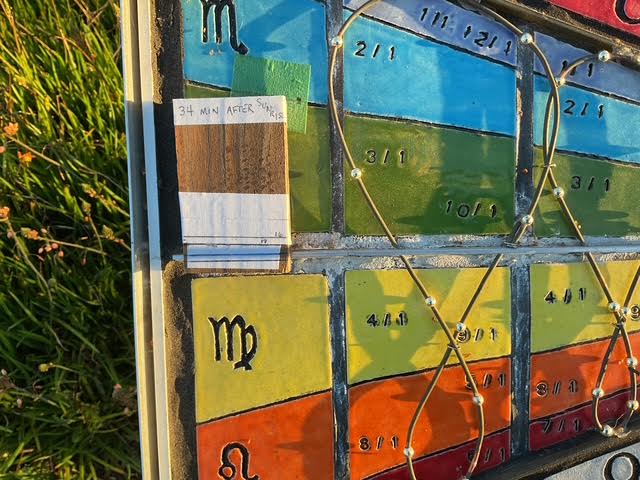
The morning of 3/20/26 arrived with clear skies. As the first sunlight hits the dial at 7:37 AM, it casts a very long shadow. Unfortunately, the shadow is already south of the midline of the east-west Equinox bar; with 8 minutes until the Equinox, the shadow should be exactly on the bar. The sundial would need further adjustment for correct alignment.
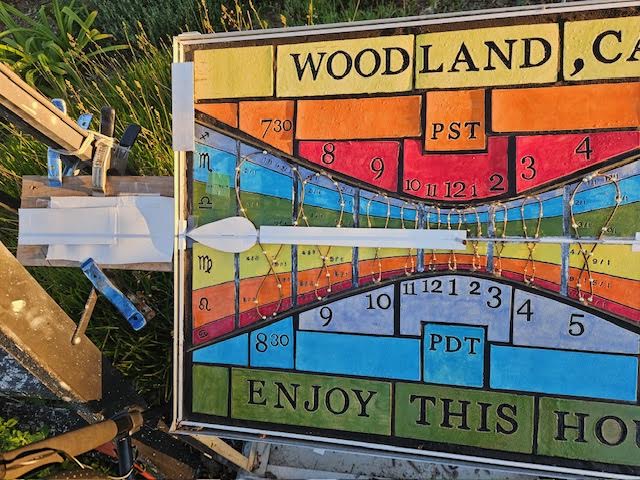
This was not a great surprise, since shadows in January and early February were falling short of the hour analemmas. As I measured the above shadows from March 16 to March 19, I also had noted the shadows were rapidly approaching the equinox bar and were projected to overshoot it by March 20:
On March 17, I corrected the gnomon, which was slightly leaning to the south. This helped, but not enough. On March 18, I raised the southern end of the dial 3.4 mm. This was the first adjustment I have made for two years; I have been reluctant since it was doing so well. The 5:44 PM shadow on March 19 was encouraging, but as seen at 7:37 AM the next morning, it was not enough.
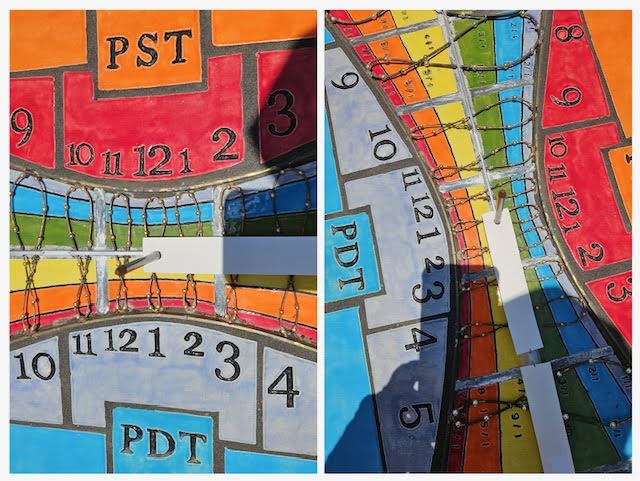
There was no time for further changes with 8 minutes to go. The midline paper strip was removed and the elevating block put in place .
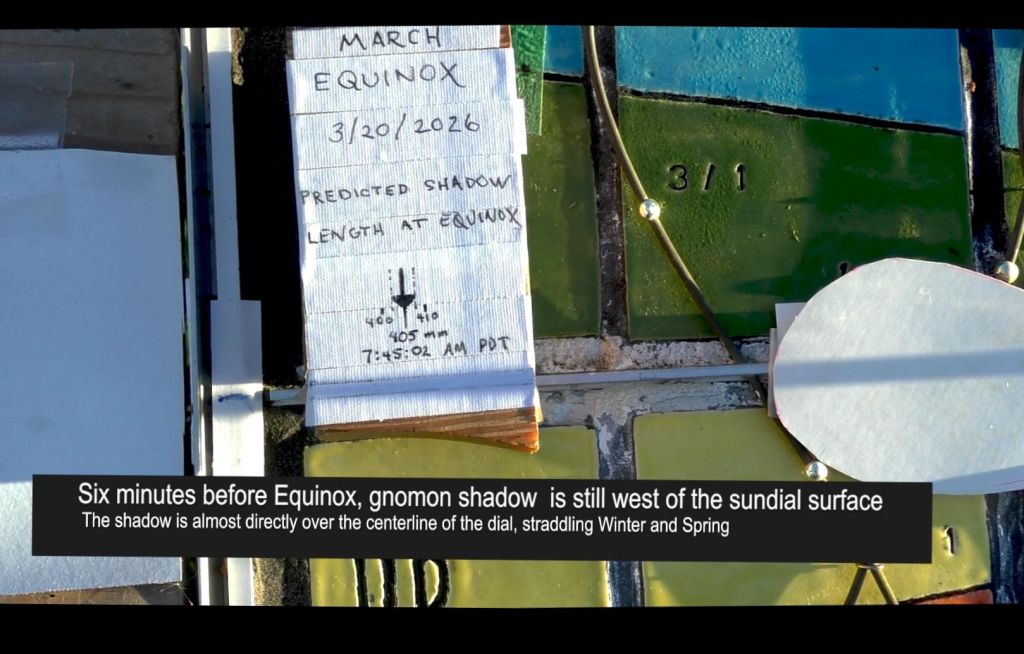
With 6 minutes to go until Equinox, the shadow had not yet reached the surface of the block.
By 7:44:49, the shadow, thin and fuzzy, showed the tip just below the Equinox bar midline, rapidly traversing the block. By 7:46:57, it was off the surface of the elevating block. By 8:10, the tree would block the sun and a shadow would not appear, now on the dial face, until after 10 AM.
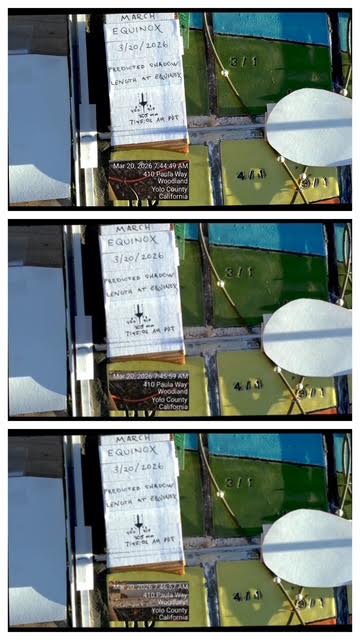
At the moment of the Equinox, the shadow length was very close to the 405 mm predicted the day before.
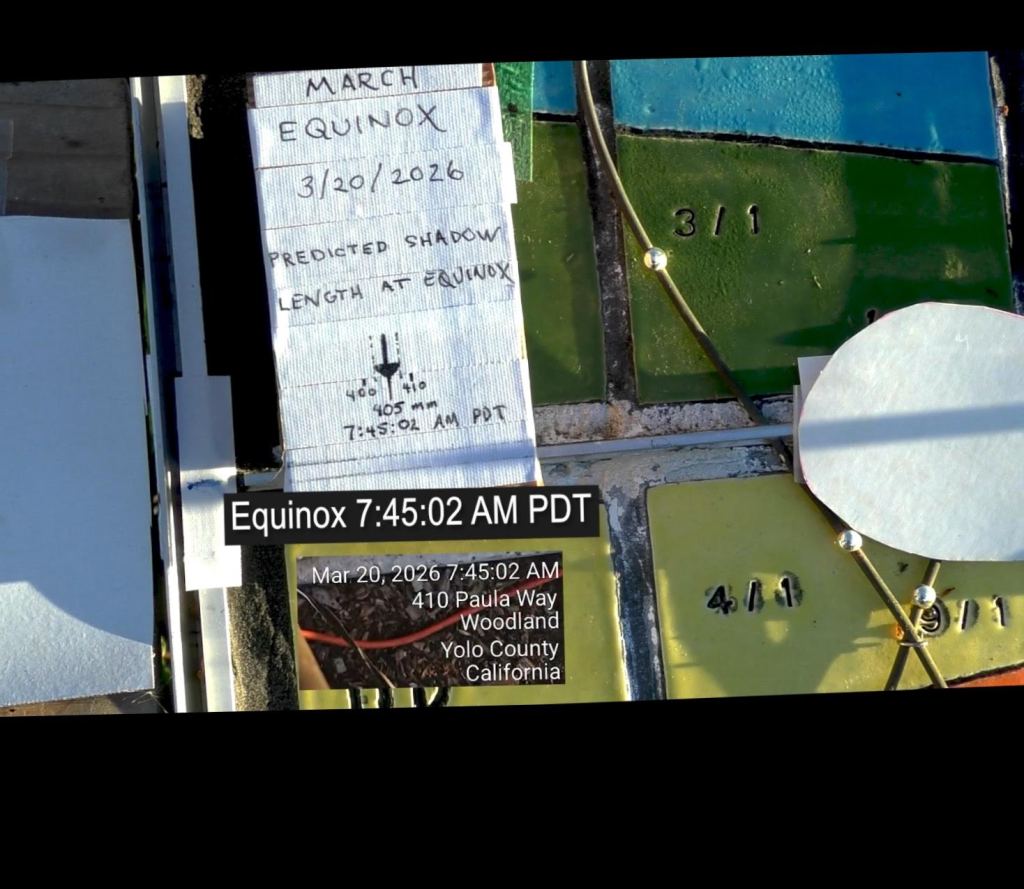
Although it would have been nice to see a crisper shadow, optical physics does not allow it. The sun has angular diameter of 0.5°. If the tip of the gnomon is large enough, it will create a totally dark shadow, or umbra. When the diameter of the gnomon tip is smaller, our eye perceives a partial, fuzzy shadow, a penumbra.
A simplified formula (there is actually a logarithmic relationship between the brightness that our eye perceives and the shadow) relating the diameter, d, of the gnomon tip and the distance, D, of the shadow is:
d/D = 2 tan(1 °/4) = 0.0087
if d/D = 0.0087, the angular size of the sun and the diameter of the tip of the gnomon are the same, and there will be a small, total, umbral shadow. If d/D is < 0.0087, the sun will not be totally blocked and the shadow will be only partially obscured, a penumbra. The tip of the WPS gnomon, d, is 2.9 mm, and the shadow distance, D, is 450 mm. 2.9/450 = 0.00716, so the shadow is all penumbra, hence fuzzy and indistinct.
It turns out that the Woodland Polar Sundial needed the Equinox more than the Equinox needed the WPS. Although the accuracy of the projected shadow can be checked at any date or time; and, due to limitations of the dial’s alignment and the perception of the shadow, it makes little practical difference several hours either side of the Equinox, this was a dramatic test of the alignment of the dial.
At solar noon, the gnomon of a polar dial on the Equinox should point directly at the center of the sun, casting no shadow. At solar noon on 3/20/26, there was still a sliver of shadow on the north side, confirming it still needed adjustment.
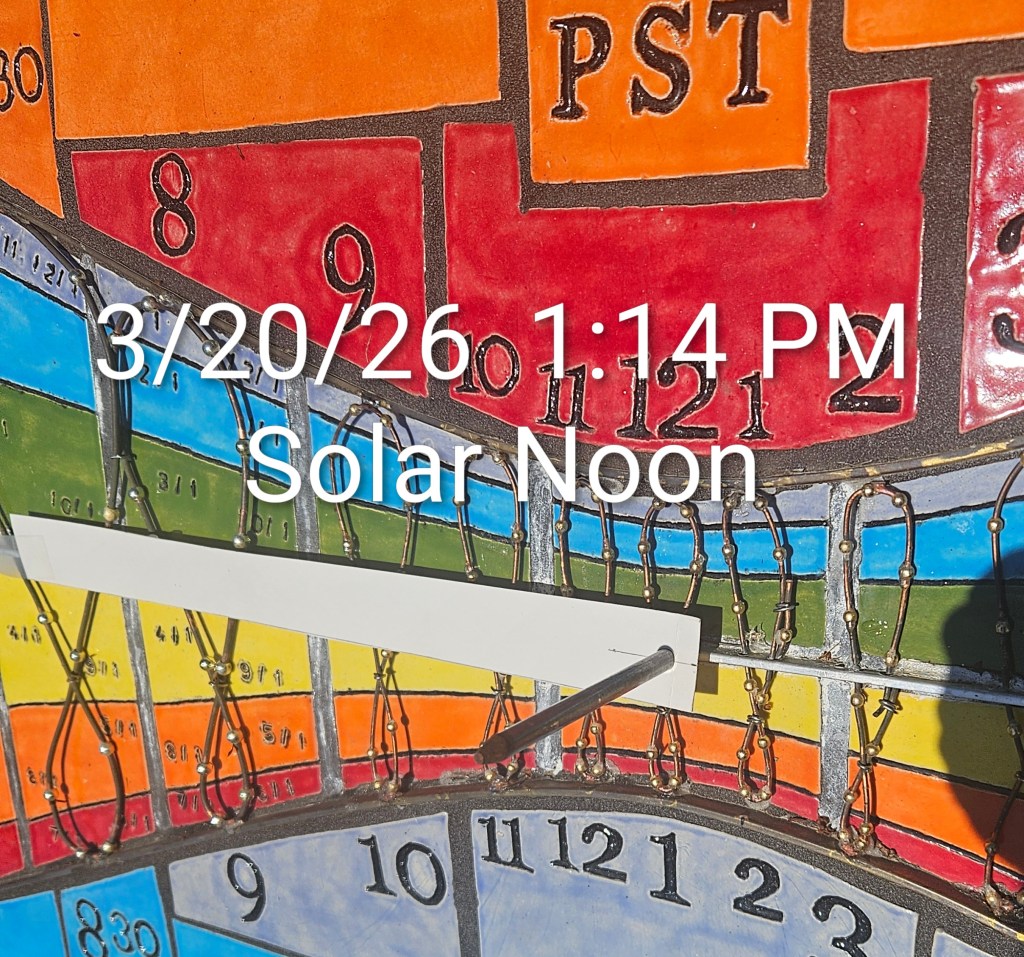
The dial “floats” in a frame. This allows shims to placed anywhere between the dial, mounted on cement board, the frame, either on the side or underneath. I use aluminum flat bar which is 1.7 mm thick. After solar noon, I had the courage to adjust the southern end 1.7 mm higher.
At the last sunlight hit the dial from the sun setting in the west , the 5:44 PM shadow is just a tiny bit south of the midline, which is about where it should be 10 hours after the Equinox. At this time, the azimuth angle is calculated to be 270.18 . The horizontal shadow length is 245mm. The vertical displacement from midline is therefore tan(.18 ) x 245 mm = (.00314)(245 mm) = 0.77 mm = .03 inch. This is large enough that it should be within the abilities of my measurements.
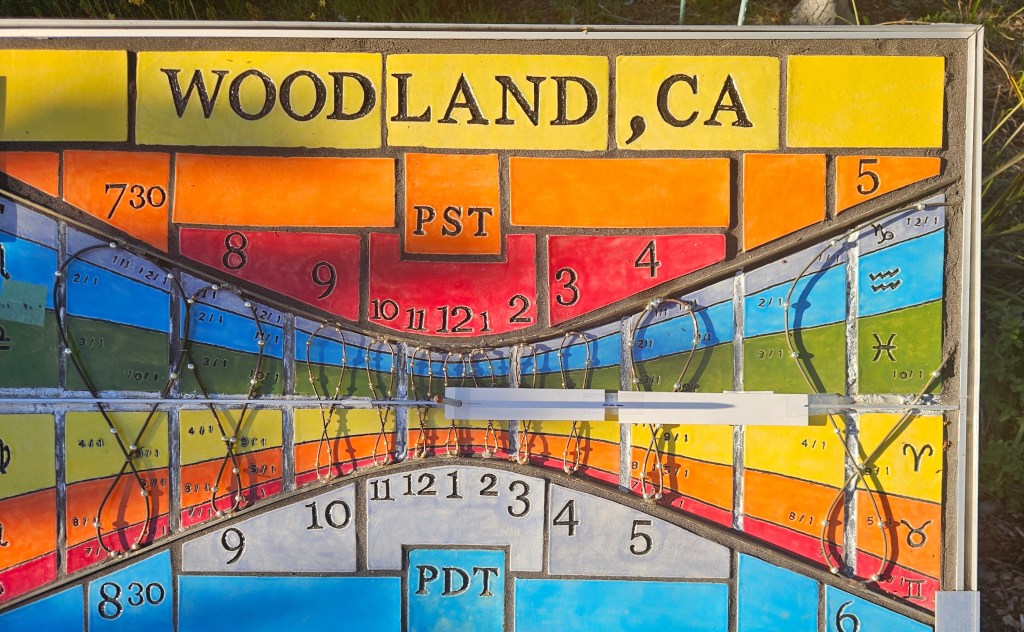
It’s difficult to judge, but I think you could say that it should be a little farther south of the midline.
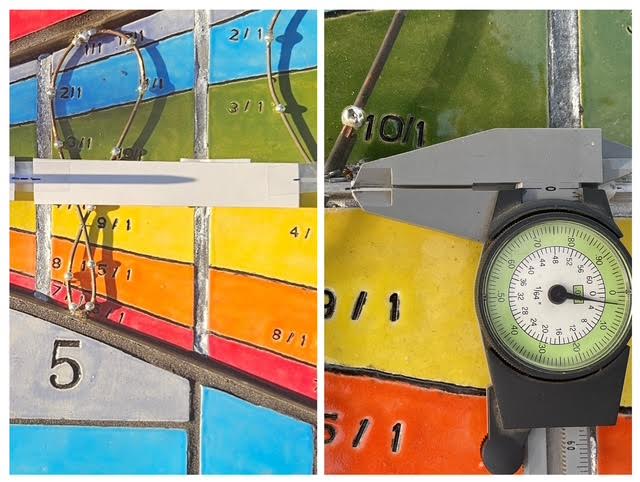
The next day, 3/21/26, at solar noon, there is no shadow at all on the north or south side. By now, over 29 hours after the Equinox, there definitely should be a shadow on the south side. This confirms that raising the dial 1.7 mm was too much! I will watch the dial for a while and start looking for 0.9 mm flat bar. I probably will need to swap out the 1.7 mm shim for a thinner one. Sundialing is a game of millimeters.
Designing and building the Woodland Polar Sundial was a daunting task, but the fun does not end after it is installed. I enjoy watching it run and documenting its performance. Although one mustn’t overestimate its abilities, it is also important to maximize its function and not expect too little from it. That is what celestial observers have done for millennia, and that’s what sundialing is all about.
The moment of the March Equinox defines the First Point of Aries, an ancient and important date for the Northern Hemisphere. Although no longer in Aries ( it is Pisces because of Precession of the Equinoxes), it marks the first day of Spring, a moment of hope and fecundity. In astronomy, it is the moment to set your sidereal clock to 00 hr 00 min 00 sec if you are lucky enough to have the sun crossing your local meridian at that moment, thereby defining the baseline for recording Right Ascension of celestial bodies.
A polar sundial on the Equinox is a spectacular experience.
Happy Equinox !!
Two minute time-lapse videos of past March and September Equinoxes can be viewed at the NASS website video page, heading “Woodland Polar Sundial.”
A two minute video showing the real time shadow progression over the elevating block on the March, 2026, Equinox can be viewed at :
https://drive.google.com/file/d/1eW7PA3CX_0ih-pGGhCVTxrBwccLlLDkD/view?usp=drive_link
 Woodland Polar Sundial
Leave a comment