Author: Rick Williams
-
March 2026 Equinox : Capturing the Moment
The March 2026 Equinox was met with tremendous anticipation at the home of the Woodland Polar Sundial. The Equinox is the great equalizer for our planet, since sunrise occurs almost due east and sunset almost due west, and the shadow of the tip of any perpendicular pole will track along a straight line throughout the…
-
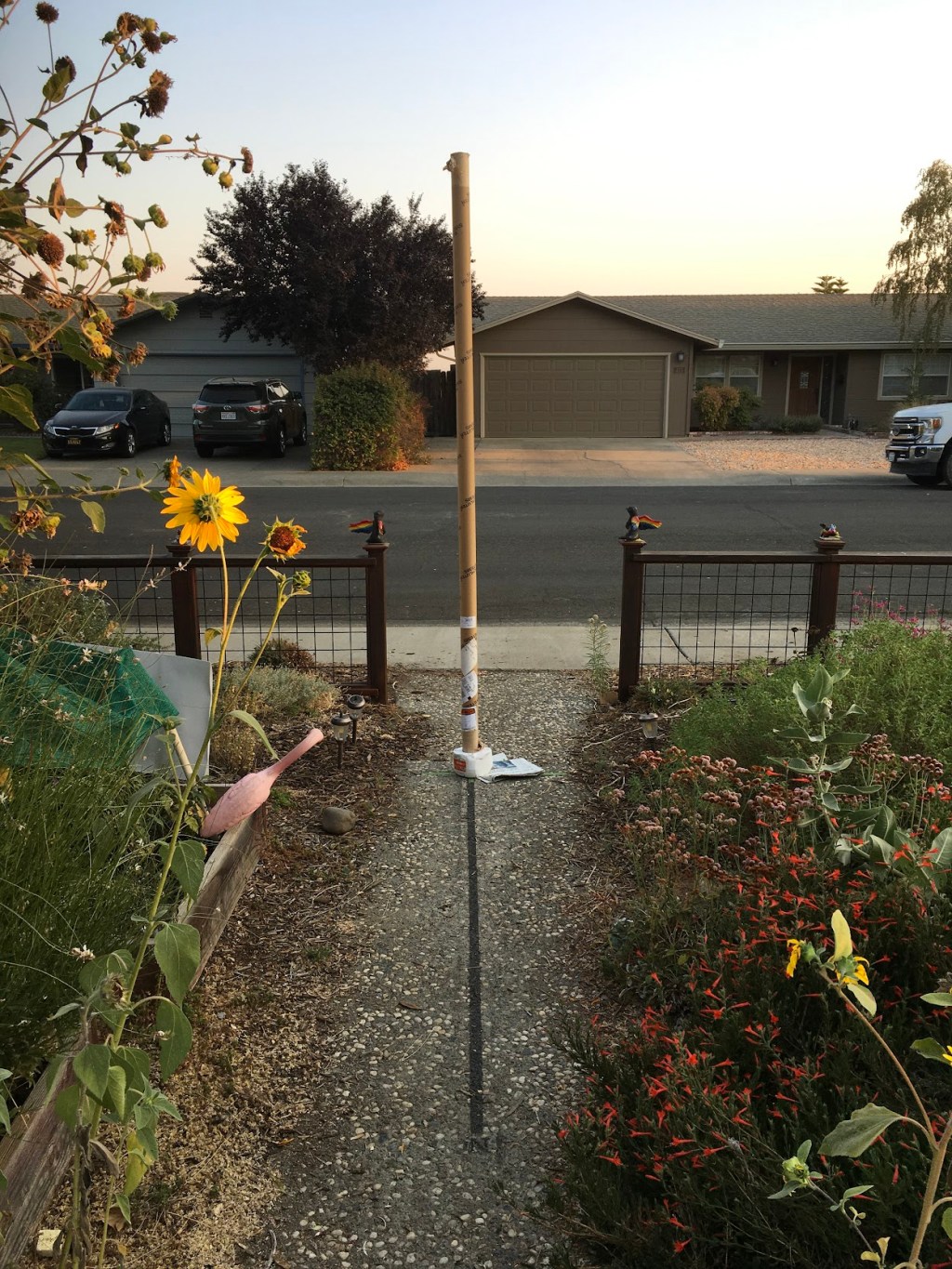
Longitude: Drawing the Line
To create an accurate sundial, latitude and longitude must be known. Using only household items, astronomical tables, and an accurate clock, I calculated the Woodland Polar Sundial’s coordinates from celestial observations made at the Paula Way Observatory. Approximate latitude is not hard to determine; the altitude in degrees from horizontal to the North Star, Polaris,…
-

Sundial Calculations
The precise construction of the Woodland Polar Dial is made possible by comprehension of the mechanics of the annual earth orbit around the sun, trigonometry, and an accurate clock. The picture above shows the shadow cast at 1:59:50 PM PST, 12/1/2023. How can the exact position of the shadow tip be calculated, so the dial…
-

How to Read the Dial
Like a clock that strikes only on the hour, the dial is designed to show standard clock time on the hour. Analemmas define the course of the sun’s shadow each daylight hour over the course of the year. When the shadow of the tip of the gnomon is exactly underneath the analemma, the time corresponds to the…
-
Videos of the Sundial
Time-lapse Videos of the Sundial Winter Solstice, December 21, 2023, by Mark Jones, Jones Visual Arts Group The shadow tracks its most northerly path. Solar noon occurs at 12:05 PM PST. Carpenter Bee sits on dial from Noon to 1 PM _________________________________________________________________________________ Declination Line, August 23, 2023 Jones Visual Arts Group The shadow tracks the…
-
First Point of Aries
As described in The Ancients post, we left our Babylonian looking out at the ecliptic intersecting the due west line after dark on the Equinox in the year 2000 BCE and seeing the edge of the constellation Aries. This was the First Point of Aries, marking the beginning of Spring in the Northern Hemisphere. It…
-
The Ancients
The Sumerians and Babylonians were keen observers, and many features of the dial would be familiar to them. They gave us the 360 degree circle, twelve “double hours” in a solar day*, 60-minute hours, 60-second minutes, and the 12 divisions of the year. There is some debate as to whether they had worked out true…
-

Analemma
Most sundials mark solar time. The Woodland Polar Sundial shows standard time, on the hour. It converts solar time to standard time by means of analemmas which are constructed for each hour. It is obvious that the sun appears to move in a north-south direction during the course of a year; it is low in…
-
Polar Sundials
Polar sundials are seldom made. Of the 6,996 dials in the British Sundial Society Registry, only 44 are polar dials. The North American Sundial Society Registry contains 1,100 dials, and there are fewer than 15 polar dials. So you are not likely to see one on your walk to the park. The most familiar sundial…
-
Equinox
On the Equinoxes, the sun rises (almost) directly in the East and sets (almost) directly in the West everywhere on Earth, except the poles. * The Equinox occurs at the moment when the celestial equator of the earth — the plane of the equator — intersects the center of the sun as the sun makes…

