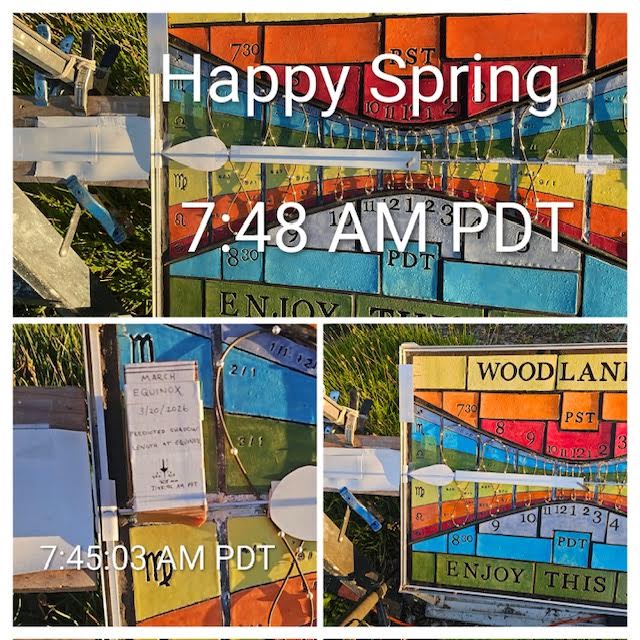
The March, 2026, Equinox was met with tremendous anticipation. Occurring at 7:45:02 AM, PDT, just 35 minutes after sunrise, 7:10 AM, this assured very long shadows from my 106 mm gnomon. At 7:45, the sun’s effective altitude ( if the dial were moved south to the Equator — see “Sundial Calculations”) is just 7.72°, resulting in a shadow length of 781 mm, 336 mm (> 13 in,) beyond the dial surface. Very small changes in time / sun altitude result in huge shadow changes. This could be a bonus as well, because the shadow will be like a fine-tune microscope dial, allowing for very small adjustments to the dial’s position. At these extreme low altitudes, the gnomon also projects with a long, thin, and fuzzy point, difficult to see exactly where it ends, rather than the blunt point of midday shadows. In particular, I wondered how close to the exact midline of the Equinox bar would the shadow be? This would be when the Equinox occurs if all is aligned properly, crossing from the southern sky (winter) into the northern sky (spring). This would allow very fine tweaking of the dial’s alignment.
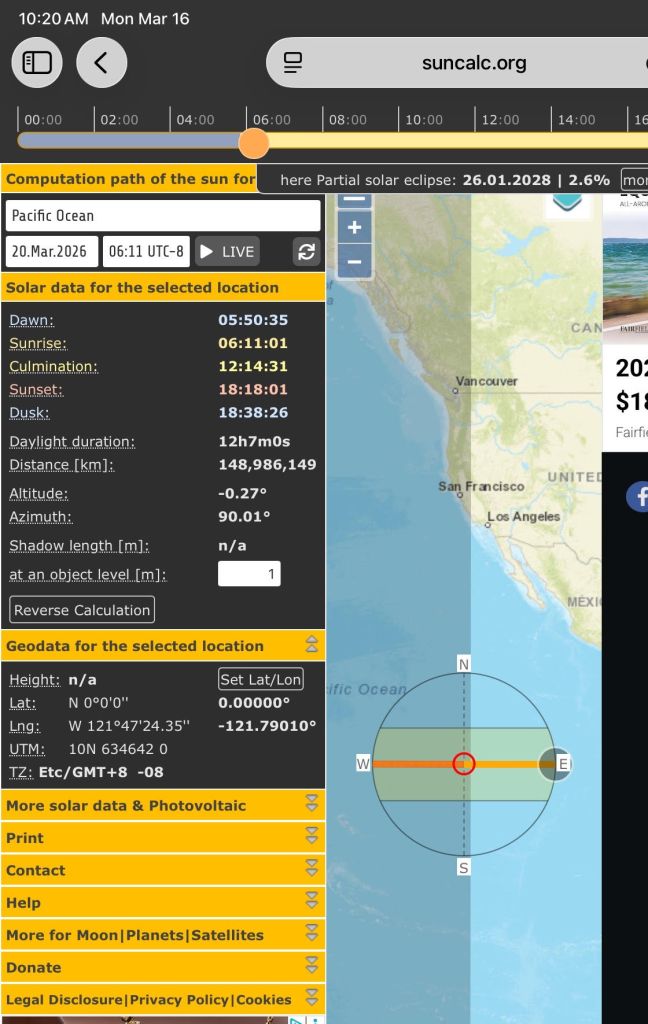
Since a polar dial is parallel to the earth’s axis, it is parallel to a horizontal dial on the equator, and perpendicular to the equatorial plane. Just like a dial on the equator, when the exact moment of the Equinox occurs, the sun is directly overhead on the equator, and passes from the southern hemisphere into the northern hemisphere. If we took the Woodland dial directly south to the equator, but kept the longitude the same, standard time would be the same and the local meridian (when solar noon occurs ) would be the same, but sunrise and sunset would be different. Here is a stimulation from Suncalc.org for the dial at 00.00 Latitude, -121.7901 W longitude at the moment of sunrise: Note that the sun is still south of the equator by 0.01° ; it is still Winter.
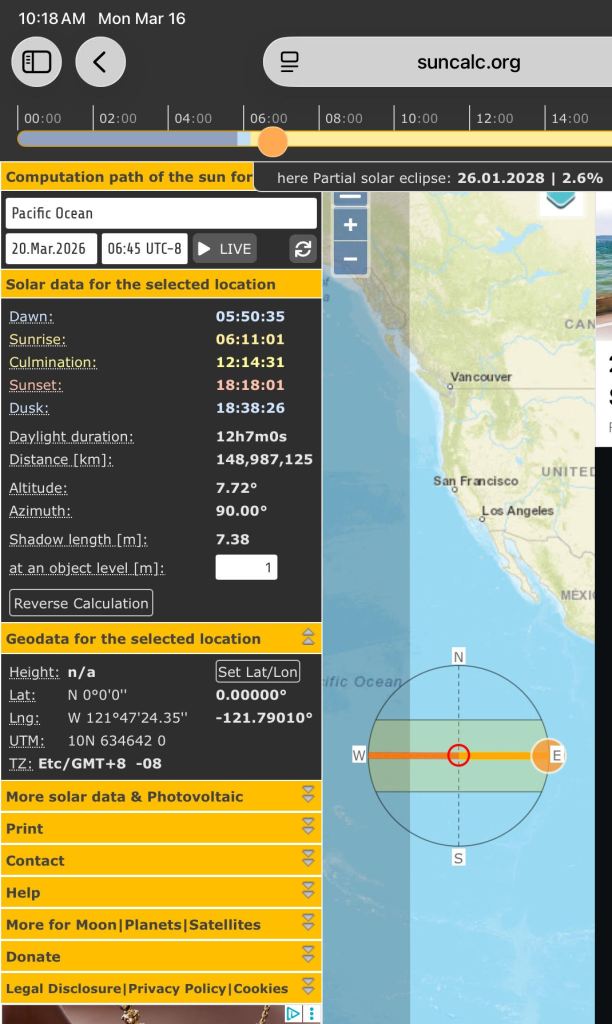
35 minutes later, at the time of the equinox, the sun now is exactly over the equator = 90.00° :
In a blink, the sun will cross north of the equator, and so the gnomon will cast a shadow below the east-west equinox bar, and Spring has begun. If the sundial is perfectly aligned, and the shadow perfectly crisp, it should show the tip of the gnomon shadow in the middle of the equinox bar at the instant of the Equinox, above the midline before the Equinox, and below the midline after the Equinox. In reality, this is impossible to achieve because of diffusion of light around the gnomon at this low altitude, let alone the daunting task of perfect alignment.
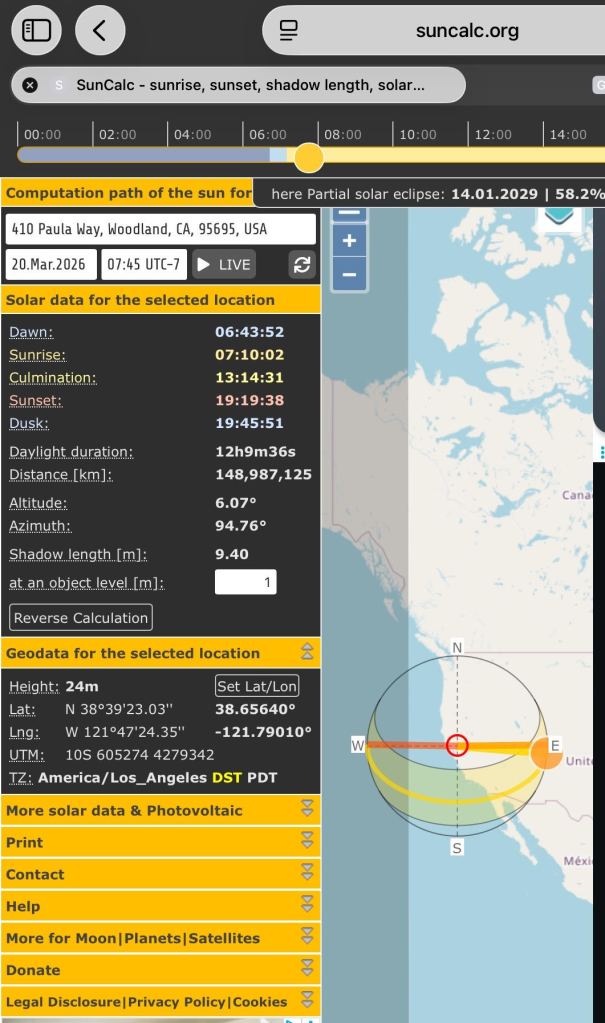
If we look at where the sun is at Woodland’s latitude, moving the dial back up to 38.6564° N, at the time of the equinox (times are same since one is UTC-8 and one is UTC -7), the sun is at azimuth 94 degrees, already in the southern sky. Since Woodland is north of the Tropic of Cancer, the sun is never directly overhead and, except for early morning and late evening Spring and Summer hours, is usually in the southern sky. Note culmination= solar noon is the same.
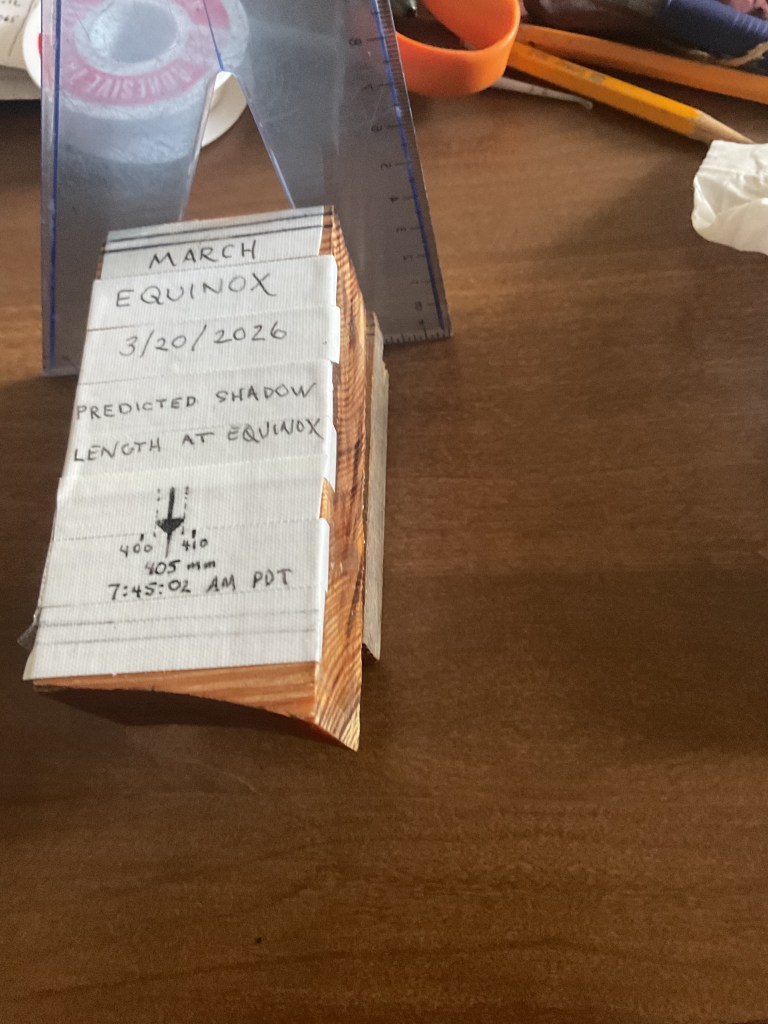
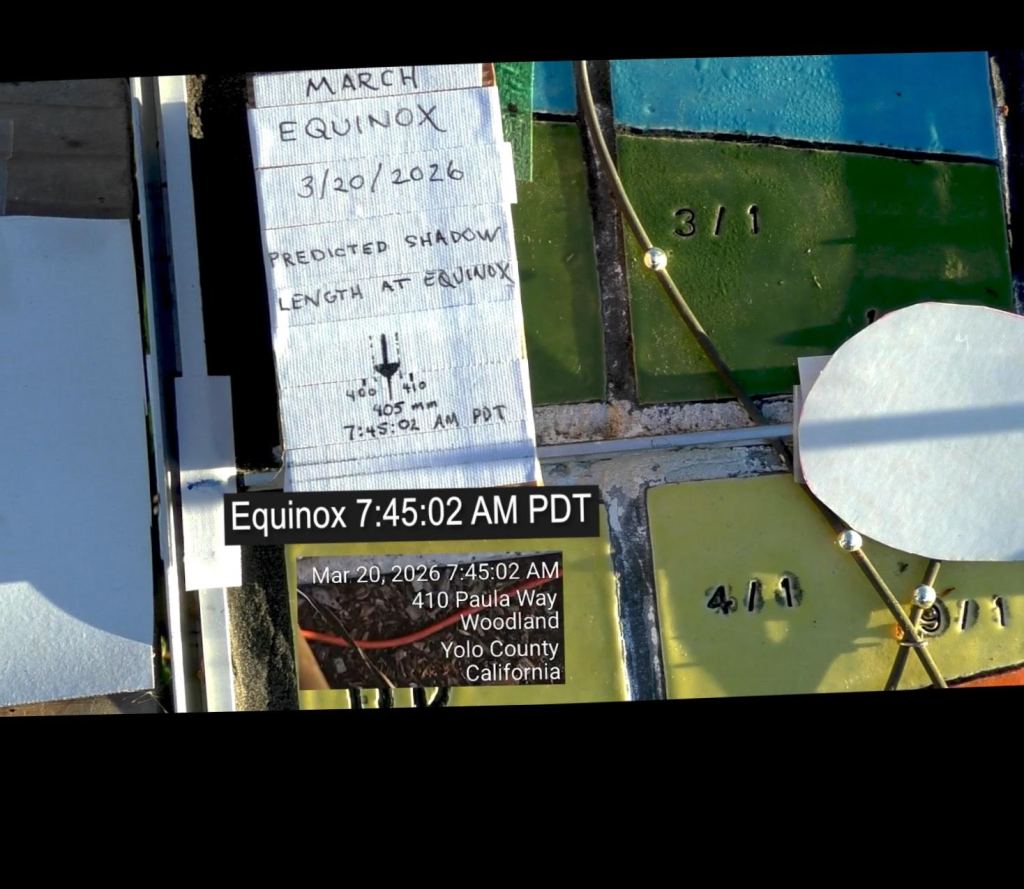
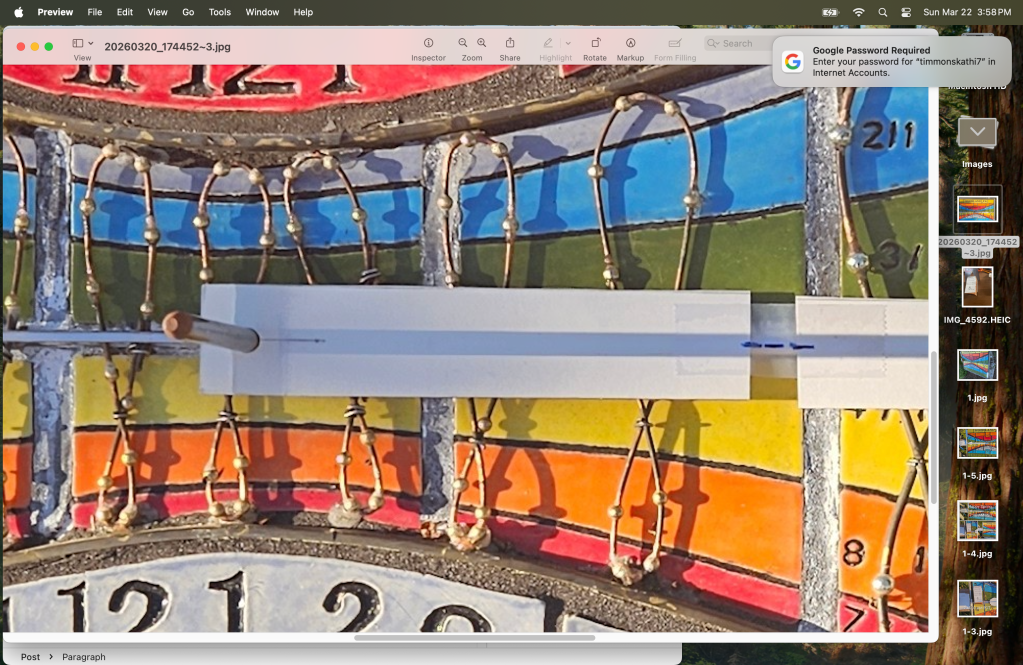
To shorten the 7:45 AM shadow , the gnomon height would have to be reduced, by putting a block on the dial surface. A block with a height of 58.2 mm would reduce the gnomon height to 47.8 mm, resulting in a calculated shadow length of 351.5 mm. Carefully outlining the Equinox bar’s position when raised, the tip of the shadow should fall in the middle of the bar when the Equinox occurs, when it arrives at the First Point of Aries, if the dial is aligned correctly.
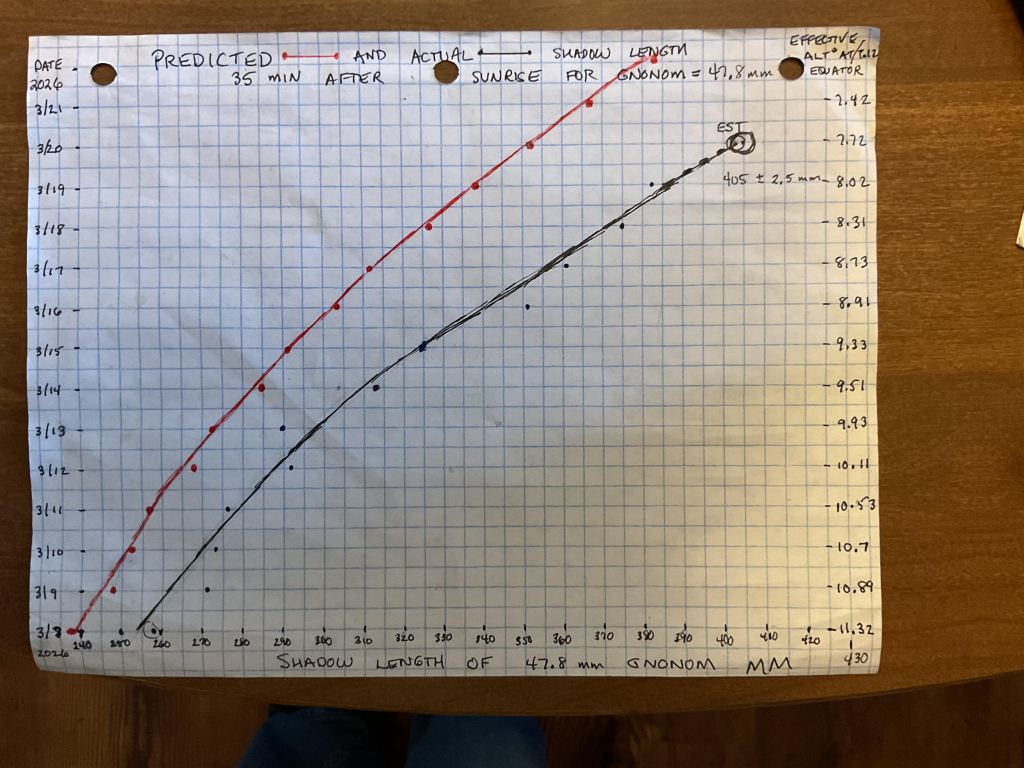
Comparing predicted calculated shadow length to actual measured length for 12 (sunny !) days before the Equinox showed calculated shadows at these very low altitudes were consistently underestimated. This may be because the western end of the dial is slightly lower than the eastern edge, and/or the shadow moves very quickly with very small changes in time and altitude of the sun, and the Suncalc.org only allows whole minute times to be entered.
Knowing this error, I graphed the predicted and actual shadow lengths for the preceding 13 days, 35 minutes after sunrise. The local altitude stayed between 5.96° and 6.15° , but the “effective altitude” at the dial’s counterpart on the equator was 11.32° on 3/8/26 and was 7.72° on 3/20. Predictably, as the altitude decreased, the shadow and the amount of error grew greater. This allowed me to predict a shadow length of 405 ∓ 2.5 mm for 7:45 am on 3/20/26.
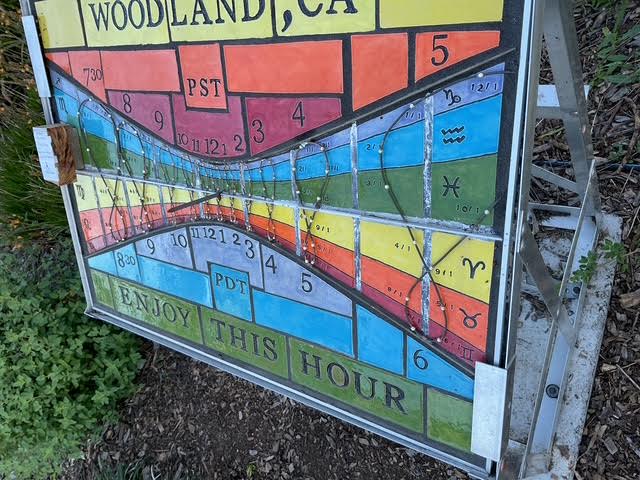
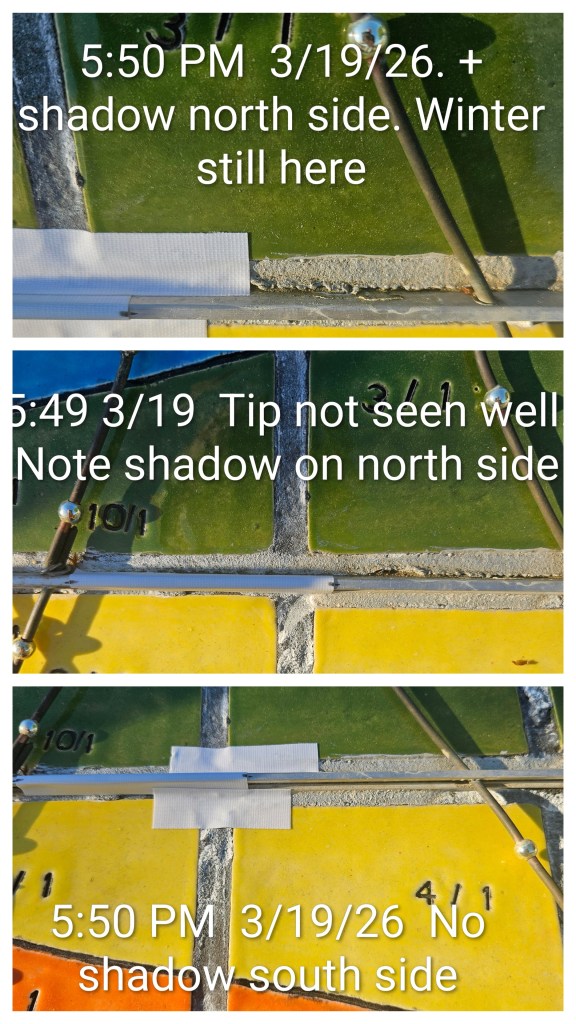
The last shadow of the dial occurs before 6 PM because of a tree west of the dial. At 5;50 PM PDT, 3/19/26, the shadow is above the midline : it is still winter.
After sunrise, the first shadow is at 7:37 AM. The shadow is very long, and is right along the equinox bar. It should be right at the midline, since the equinox is 8 minutes away, but it is slightly below the midline. The equinox bar is 2.8 mm wide, so it is less than 1.5 mm from center.
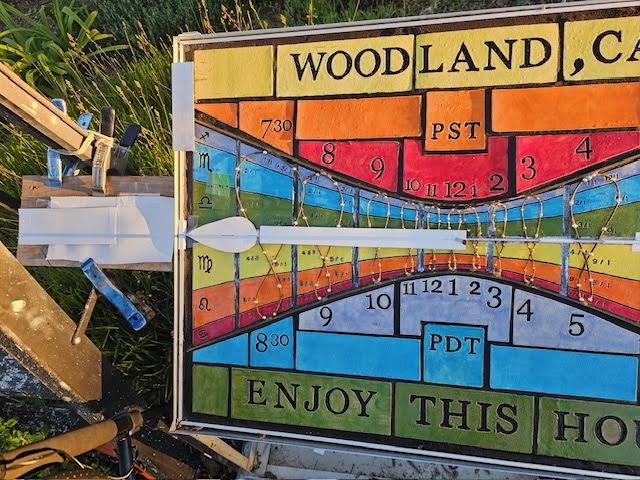
At the moment of the Equinox, 7:45:02 AM, the shadow is just about where it was predicted, and again, is just below the midline. Spring has arrived.
At 7:59 AM, the shadow is becoming more defined and clearly is just below the midline. Unfortunately, a large tree will soon block the sun until after 10:30 AM.
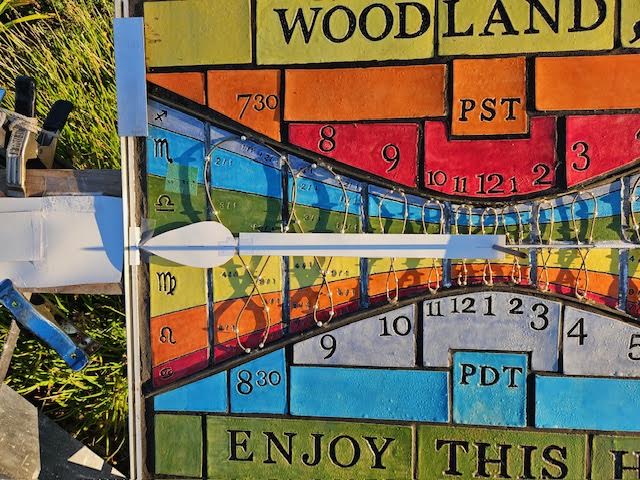
The shadow will continue to track west to east along the equinox bar for the entire day. I have not made any adjustments to the dial for two years, since it has been performing so well, but with this information I slightly raised the southern side of the dial. The afternoon shadow after adjustment looks very good; time will tell if this will overshoot in the other direction. Sundialing is a game of millimeters.
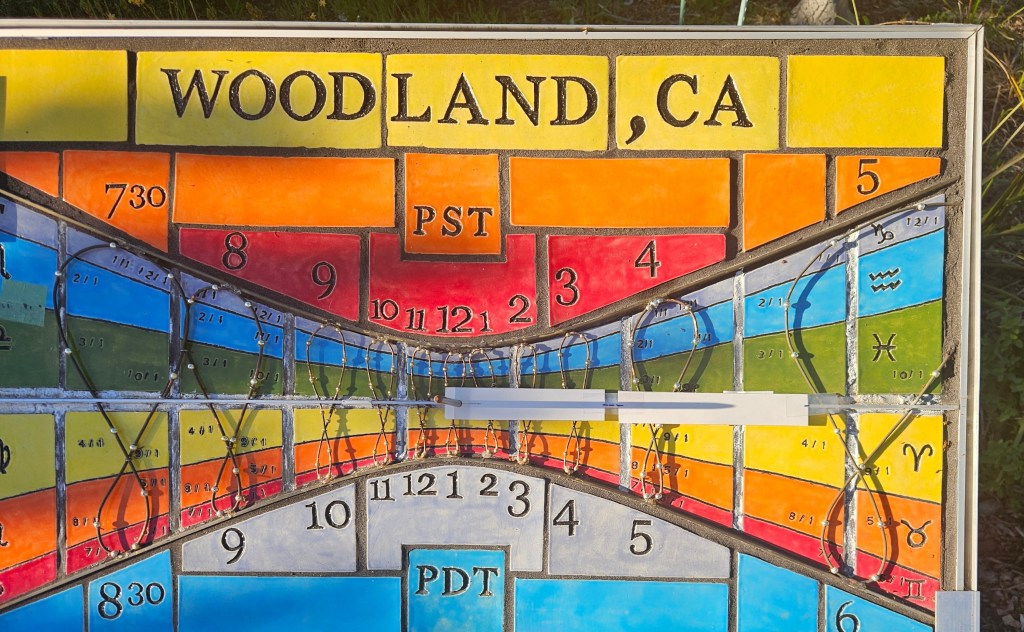
HAPPY EQUINOX !!!!
Two minute time lapse videos of of the entire day’s shadow excursion for the Spring and Fall Equinoxes can be viewed from the link on the Home Page or in the Topic “Videos.”
A two minute video showing the shadow passing over the elevation block on the March, 2026 Equinox can be viewed here :
https://drive.google.com/file/d/1_ersmCBEdLK3EntedqVnt62GpswfROly/view?usp=drive_link
 Woodland Polar Sundial
Leave a comment