The Sumerians and Babylonians were keen observers, and many features of the dial would be familiar to them. They gave us the 360 degree circle, twelve “double hours” in a solar day*, 60-minute hours, 60-second minutes, and the 12 divisions of the year.
There is some debate as to whether they had worked out true trigonometry with their base 60 sexagesimal numbers, 1000 years before the Greeks, but they were certainly very good at computing right angles to a high degree of accuracy. Cuneiform tablets have been discovered which define land holdings across large distances very precisely. Rather than using angles and irrational sines and cosines computing to many decimal places, they recorded integral ratios of rectangular sides and diagonals that would exactly produce right angles. The famous Plimpton 322 cuneiform tablet (ca. 1822-1762 BCE) records many Pythagorean triplets: 119, 120, 169 ; 3367, 3456, 4825 ; 65, 72, 97; and more.
The sun reaches its maximum height at solar noon, when it is due south, in the Northern Hemisphere, defining a south-north line. This is how I set up my north-south line:
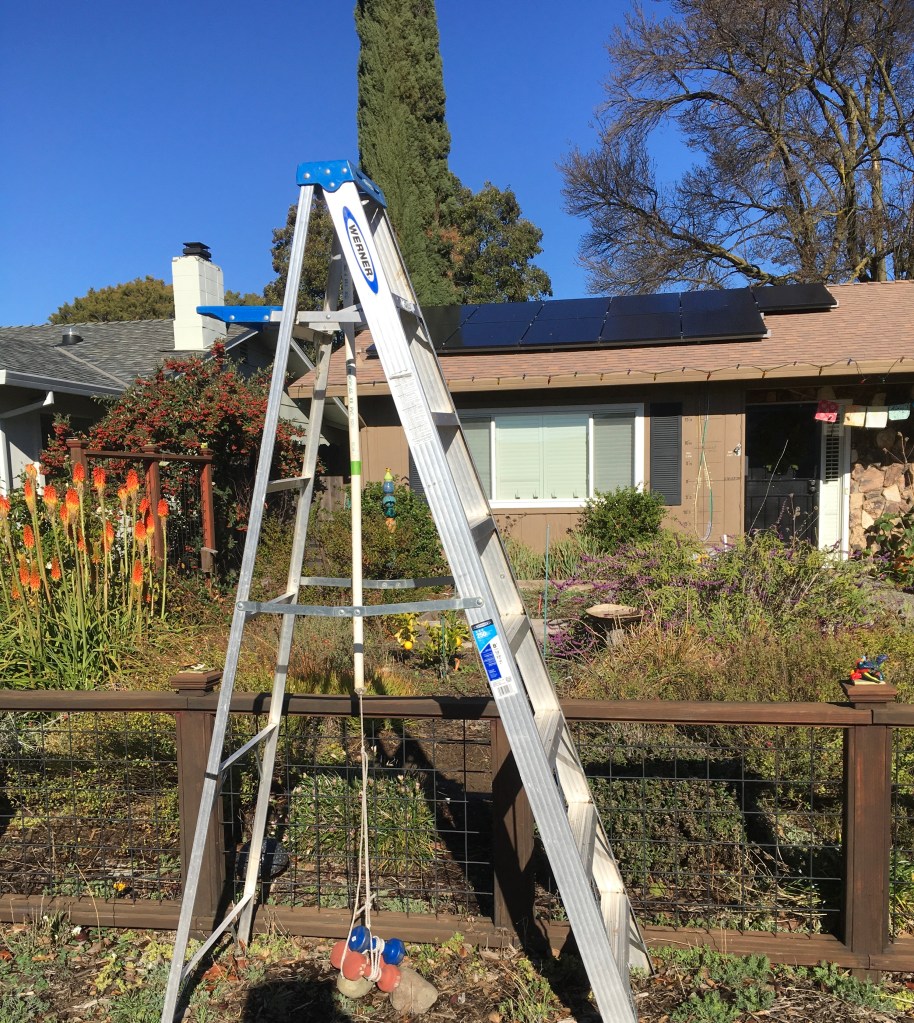
I had the benefit of knowing exact solar noon on any given day, and so did not have to spend time watching for the shadow of a plumbed line to reach its shortest length and turn from slightly NW to slightly NE. I did this on 12/12/22, when the shadow was long, and put my markers along the shadow.
Once you have N-S, then E-W follows, whether you do 3-4-5 triangle multiples (or your favorite Babylonian triplet), right angled squares, compass (magnetic declination of Woodland is 13 deg 9 min E), or just make sure the frame is at right angles. The Babylonians had this down.
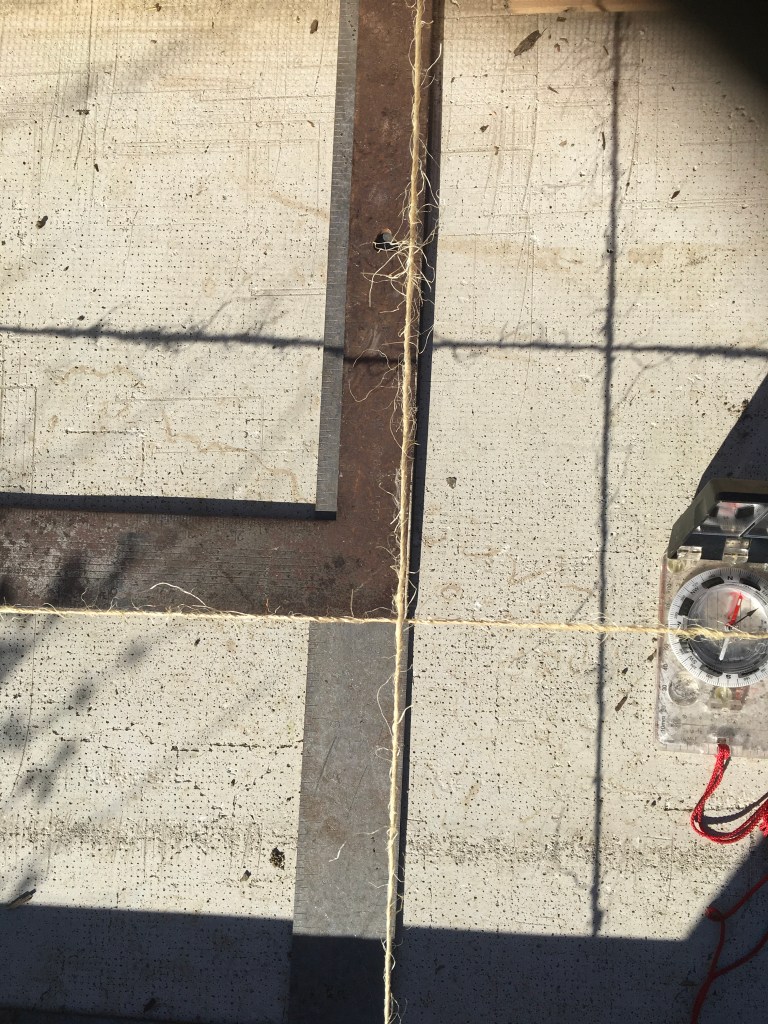
The Ancients knew the true east-west line, and by watching the sun rise and set with a clear horizon, thanks to your local pyramid, ziggurat, or observatory in the desert, the Equinoxes could be identified with precision.
They also knew that the sun, and the planets at night, follow the same path in the sky, the ecliptic. They named 12 sections of the Zodiacal year after constellations that the path of the ecliptic passes through during the year. They needed to define a starting point that would be valid for everyone — you couldn’t say Scorpio starts when Antares (its brightest star) is over Fred’s house, or even Mt. Diablo, on the Summer Solstice after sunset — that wouldn’t work over even short distances and intervals. It had to be an extra-terrestrial point of reference. They chose when the ecliptic intersects the horizon on the Equinox. The sun sets due west and east on the Equinox , so those are set points anywhere in the world. Just as the sun’s rays are virtually parallel as they hit the earth, since we are so far away and the earth is so small compared to the sun, the reverse is also true, and we gaze west at the sun and the planets, our view of the ecliptic on the Equinox is parallel to the view at the Equator. Of course, they chose the Spring Equinox, a time of hope and rebirth, rather than the Fall Equinox, but either would work just as well.
Besides watching the sun rise or set, you can also define this point easily at night. For most of March, 2023, we earthlings were treated to a dazzling display, as Jupiter and Venus, traveling along the ecliptic, blazed away in the western sky. The moon’s path is also close to the ecliptic, but may be as far as 5 degrees off, because of its orbit. This is how the sky looked , facing west, on 3/22/23 :

The green line of the ecliptic plots just north of due west – Spring has begun and the sun will rise and set a little farther north each day until the Summer Solstice. The Equinox occurred on 3/20/23 — on this day the green line would have interested the horizon at due west. On 3/19, the ecliptic would have been just south of due west. You don’t have to be a Babylonian to see that !
As the sky darkens, if you were a Babylonian in 2000 BCE, you would see the imaginary ecliptic just touching the western edge of the constellation Aries — the “first point of Aries.” They named it the Ram and named most of the other Zodiacal signs that follow.
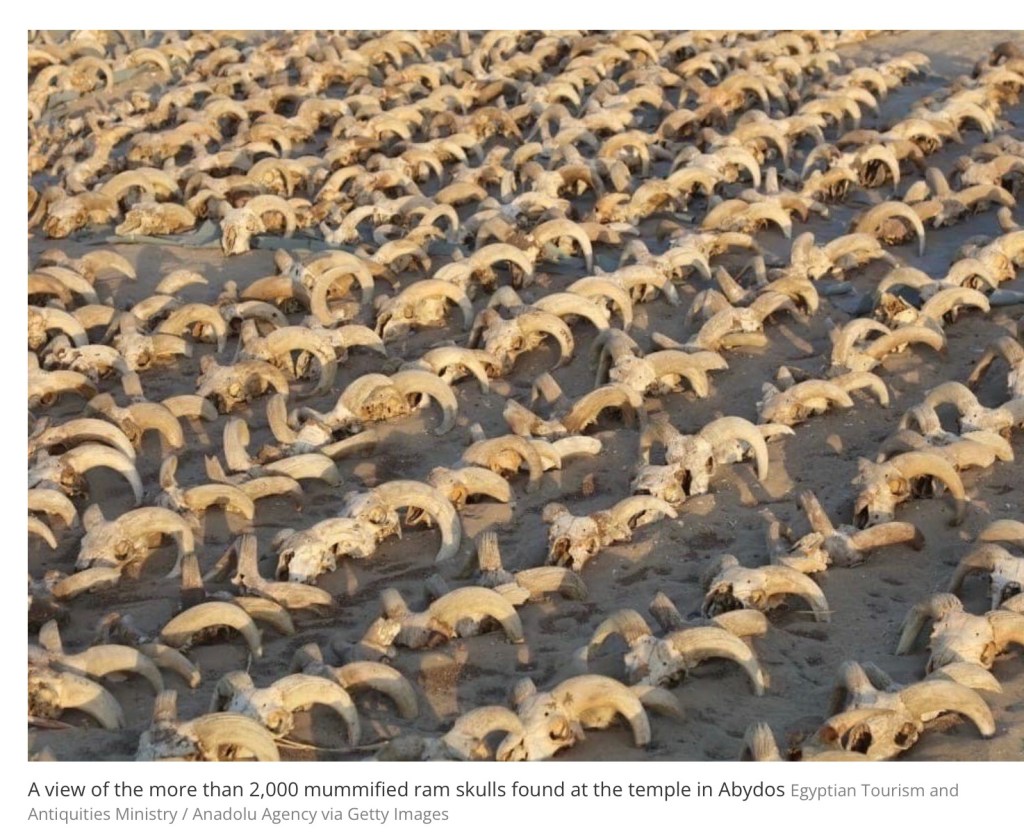
It is hard to overstate how important this date was. It could be predicted with confidence that Spring was on the way — fertility and verdancy would follow. Crops could be sown, fruit trees would blossom, and it was time to castrate your calves and donkeys. Aries, the Ram, has been a symbol of strength and fecundity ever since. Recently, excavation of the ancient city of Abydos, Egypt, uncovered over 2,000 mummified ram skulls, left as tribute to Ramses II. Ramses II died in 1213 BCE after a 66 year reign. Almost 1,000 years later, in 332-330 BCE, the temple was constructed for him in Abydos. That’s devotion !
A short excursion into the fields and farms of the fertile Sacramento Valley, where Woodland lies, would show that the Ram still holds sway to this day:


The Woodland Polar Sundial was nearing completion around March 17, 2023. It still needed to be mounted, oriented, and calibrated before the Equinox, March 20, when the proof of its worth would be whether it would track east to west and be on the cusp of entering Aries. It had been an unusually cool and wet winter, much needed for our drought, but not promising for sundialing. Spring seemed far away. Here is the highly unusual 10 day forecast from 3/9/23 to 3/18/23:
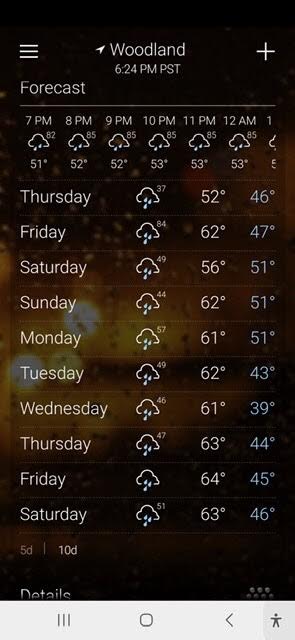
There were a few brief hours of sunshine when I would run out and make measurements and adjustments, but there was much doubt about the Big Day.
On 3/20/23, 8:00 AM, the dial was still wet but the sun shone:

It works ! The sun is rising due east; Spring is here. Mirabile dictu, it stayed sunny most of the day (see “Equinox”), but the rains returned over the next days. The sun shone 3/28/23; below shows 5:12 PM PDT. Now the sun has had 8 days to continue its northern trek, rising and setting further north, and the shadow lies in Aries (yellow) from 3/20 to 4/20/23. Plant the crops; the trees will be in bloom.


Almond groves blooming, Yolo County, West of Woodland, March , 2017
There is a bit of a hiccough with this narrative — the Precession of the Equinoxes — see “First Point of Aries.”
If you were a Sumerian or Babylonian, much of this would make sense. You would not be at all surprised to look due west at sunset and see Jupiter and Saturn lined up on the Equinox — it is the first day of Spring, after all. As far as I am aware, we do not know their symbols for the Zodiac, but I think they would recognize the Ram, even after all these millenia.
One thing would puzzle them — what the heck are those curvy copper lines (you can’t say “figure 8” to a Babylonian) ? They did not know about analemmas.
*Most of our clocks have 12 hour divisions, and the clock goes around twice in a day, rather than having 24 hour divisions for a day.
 Woodland Polar Sundial
Leave a comment