As described in The Ancients post, we left our Babylonian looking out at the ecliptic intersecting the due west line after dark on the Equinox in the year 2000 BCE and seeing the edge of the constellation Aries. This was the First Point of Aries, marking the beginning of Spring in the Northern Hemisphere. It is no longer a valid observation, and yet is with us still.
As the earth revolves around its axis, the axis also wobbles like a top, the poles making a circle every 25,765 years. 4,000 years ago, the North Star was Thuban, in the constellation Draco, not present day Polaris in Ursa Minor (the Little Dipper). Mighty Vega, in the constellation Lyra, fifth brightest star in the sky, was the North Star in 12,000 BCE, and will be again around 13,700 CE. The plane of the equator has thus tilted over this time. When you look west on March 20, 2023, you will see the ecliptic is in Pisces , not Aries. It was in Aries from 2000 BCE (remember our Babylonian saw it just touching the western edge) to 100 BCE, and will be in Pisces from 100 BCE to 2700 CE. The position of the ecliptic on the Equinox will then continue to proceed (or precess, since that is the term that describes change in direction of the rotational axis of a rotating body) throughout the Zodiac, ending back at Aries around 22,000 years from now. This is called the Precession of the Equinoxes.
As the earth wobbles, the plane of the equator projected into space – the celestial equator – drifts westward along the ecliptic at a rate of about 50 arc seconds per year. There are 360 degrees in a circle = 360 X 60arcmin/degree = 21,600 arcminutes in a circle = 21,600 arcminutes X 60 arcsecond/arcminute = 1,296,000 arcsecond in a circle divided by 50 arcsecond/year = about 25,920 years to complete a circle. This seems a very small annual change, but can be visualized. The plane of the Tropic of Cancer is parallel to the plane of the equator. Because of the wobble of the axis of earth, the Tropic of Cancer is drifting southward 0.468 arcsecond of latitude a year = 49 feet per year. Carretera 83, a highway in Tamaulipas, Mexico, which crosses the Tropic of Cancer, has markers showing the changing position of the Tropic from 2005 to 2010:
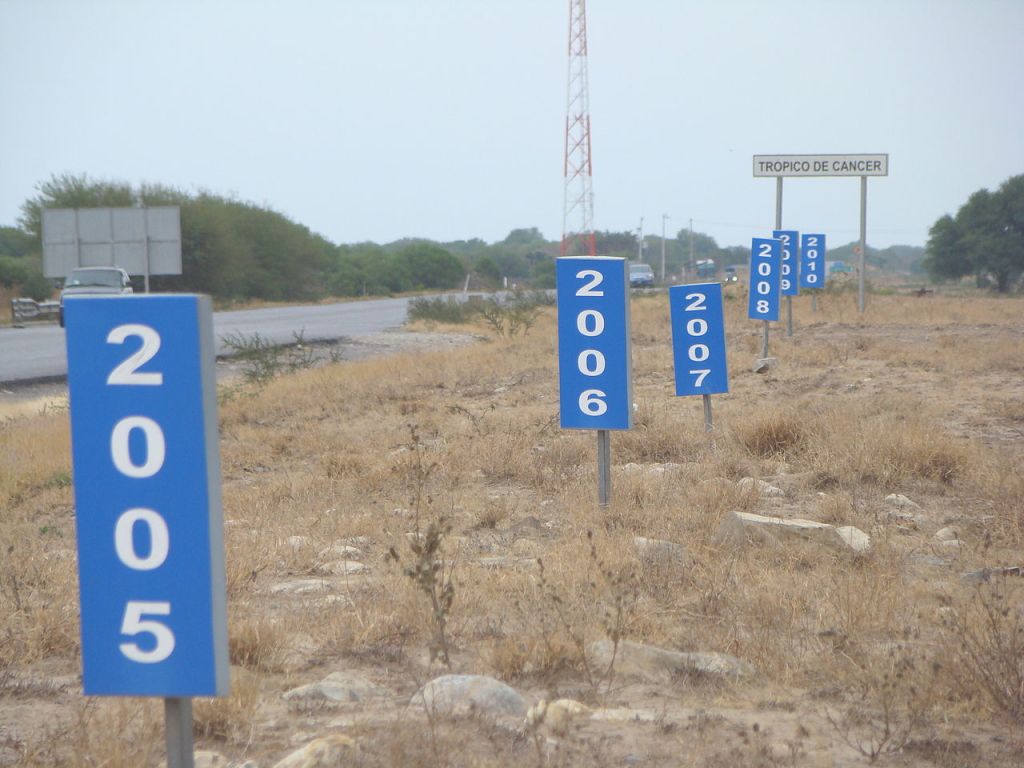
Photo by Roberto Gonzalez, CC BY-SA 4.0 Wikimedia Commons
Similar to latitude and longitude, modern astronomers define the position of a star by its declination (See Declination) and right ascension, which is the angular distance from a zero degree starting point on the celestial sphere. Just as longitude on the surface of the earth needs a starting point, 0 degree longitude at Greenwich, the celestial coordinate system’s starting point, its prime meridian, is where the celestial equator meets the ecliptic on the Spring Equinox — the First Point of Aries.
Even though the First Point of Aries is no longer in Aries, it is still called that, and represented by, what else,

Since the position of the First Point of Aries is continually changing due to precession, star coordinate catalogs using right ascension must be updated at frequent intervals, and then further adjusted as to how much time has elapsed since the update.
In a nod to the Ancients, the Woodland Polar Dial uses the ancient Babylonian Zodiacal dates. The Equinox and Solstice lines are derived from astronomy; the black declination lines of the Zodiac are artificial, but very ancient, markers of passage of time for us humans.
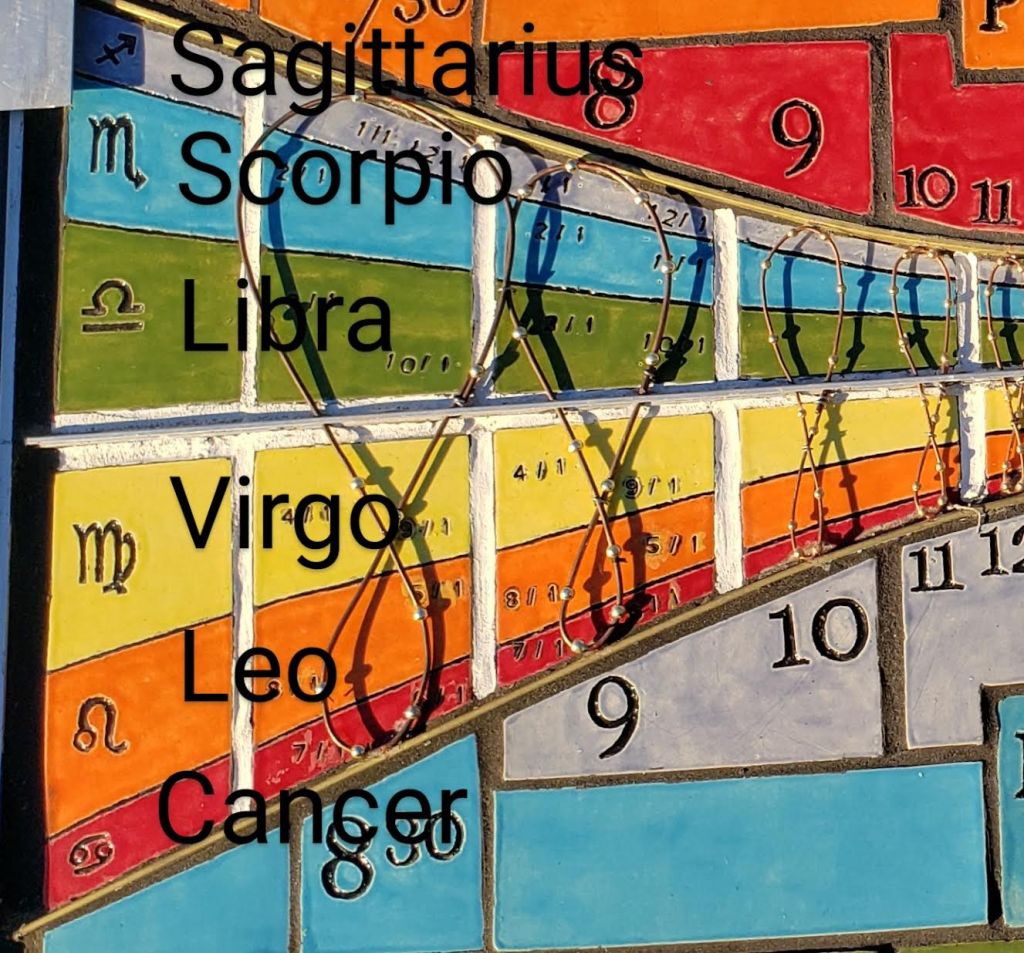
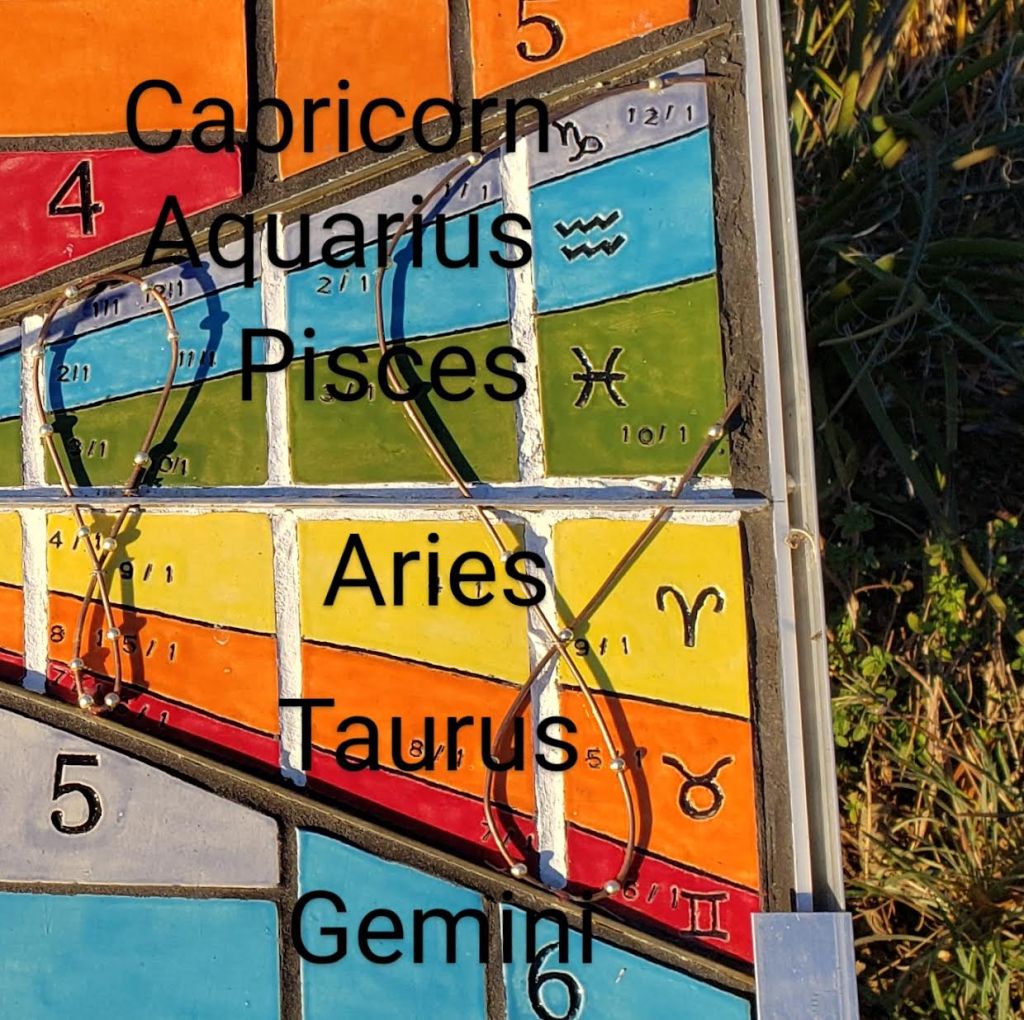
 Woodland Polar Sundial
Leave a comment