Polar sundials are seldom made. Of the 6,996 dials in the British Sundial Society Registry, only 44 are polar dials. The North American Sundial Society Registry contains 1,100 dials, and there are fewer than 15 polar dials. So you are not likely to see one on your walk to the park.
The most familiar sundial is the horizontal dial. The shadow-casting gnomon should be tilted at an angle equal to the latitude of the dial; if it is a rod, it would point toward the north pole, which is the position of the North Star above the horizon. With a protractor and practice, you can walk out on a clear night and find your latitude.
Vertical dials are often seen on the walls of buildings. Here the gnomon is also pointed parallel to the earth’s axis, again pointing to the north pole.
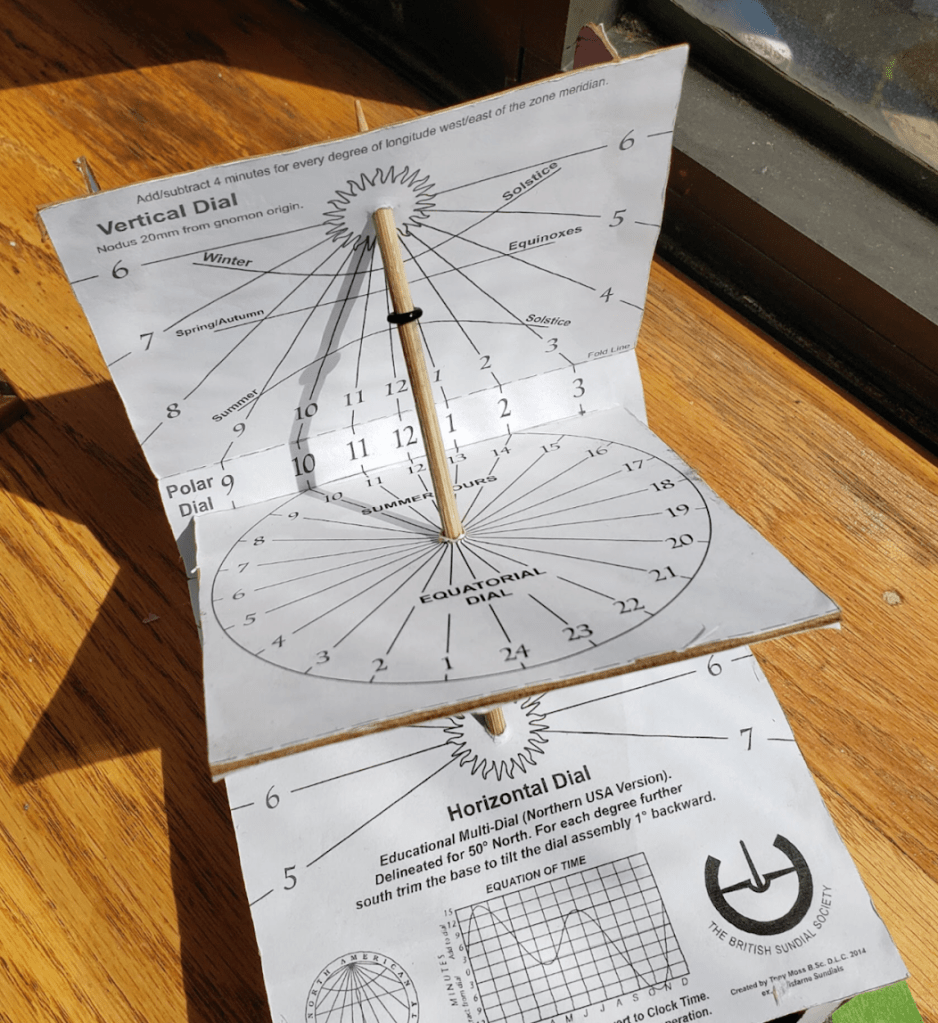
Equatorial sundials often look like a disc skewered by a rod and set at an angle. The plane of the dial is parallel to the plane of the earth’s equator, and thus is perpendicular to the axis of the earth.
A polar dial is perpendicular to the equatorial dial. It is parallel to the axis of the earth. There are an infinite number of planes parallel to the axis, but only one that is oriented exactly east-to-west, as is a polar dial.
The Woodland Polar dial is tilted at 38.65 degrees; the left and right frame bars point to the North Star, the gnomon is perpendicular to the dial surface:

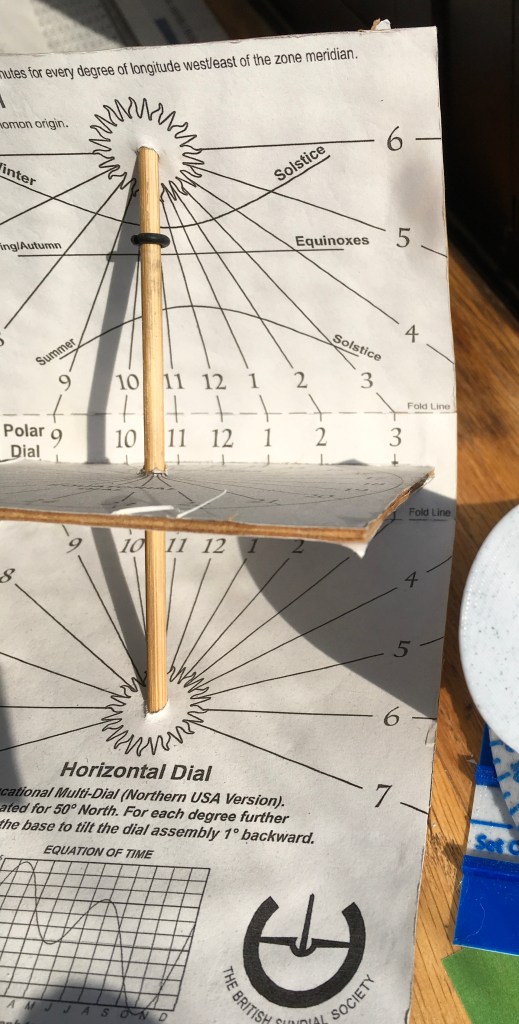
To visualize these relationships, study the Tony Moss Multi-Dial, which you can print and construct yourself, specific for your latitude, out of cereal box cardboard, glue, and a kebob skewer.
Here is one I made. The equatorial dial is at right angle to the narrow polar dial strip, which is the same angle as the gnomon. It is about 9:30 AM, solar time:
Here is a different day, which shows the equatorial dial surface better. It is 10 AM, solar time:
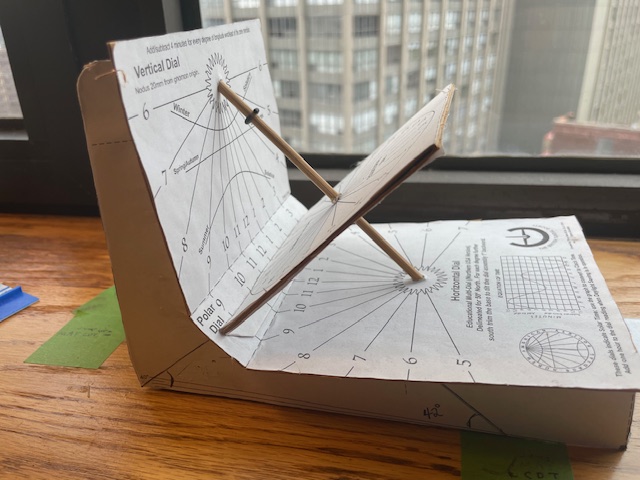
Tony Moss Multidial in window in Chicago, IL. Gnomon set at 42 degrees. Polar dial is parallel to the gnomon and perpendicular to the equatorial dial.
One disadvantage of a polar dial, as seen above, is that the gnomon casts a long shadow early and late in the day, and short shadows around noon. The hours are not evenly spaced. This worked out OK at my location, since trees block the early and late hours anyway, and I could make it large enough that the mid-day hours were not too crowded.
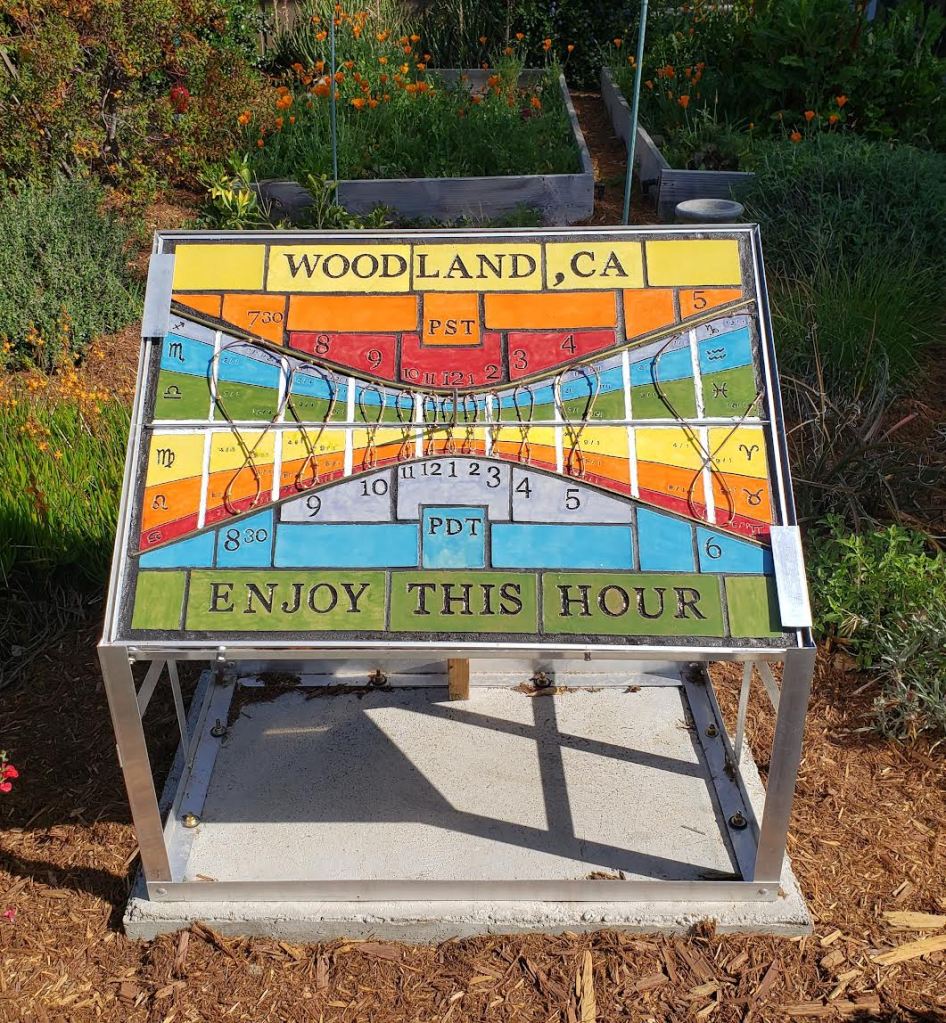
Dial on 4/23/2023, 10:00 AM Pacific Daylight Time (above). Time is read on the right side of the figure-8 analemma on this date.
The shadow is very long by 6 PM:

April 15, 2023, 6:00 PM, PDT. The figure-8 analemma criss-crosses around April 14th, so time is read on the right side. Note 4/1 is on the left side and 5/1 is on the right side.
 Woodland Polar Sundial
Leave a comment