On the Equinoxes, the sun rises (almost) directly in the East and sets (almost) directly in the West everywhere on Earth, except the poles. *
The Equinox occurs at the moment when the celestial equator of the earth — the plane of the equator — intersects the center of the sun as the sun makes its apparent annual journey along the ecliptic. It is very close to the moment when the declination of the sun is zero, though not exactly, since the earth does not sit precisely on the ecliptic.
At the Equinox, a line between the centers of the earth and the sun would be perpendicular to the earth’s axis. On the Equator, at solar noon on the Equinoxes, the sun will be directly overhead. A perpendicular pole on the Equator will point directly to the sun and will cast no shadow at the instant of the Equinox, whereas at all other times, the sun would be north or south of the celestial equator, and thus cast a shadow.
Since the plane of a polar dial is parallel to the axis of the earth, the dial is tilted at the same angle of its latitude; in Woodland, this is 38.65 degrees. The plane of the Equator is perpendicular to the axis of the earth. The dial’s gnomon is perpendicular to the dial plane, so it is also perpendicular to the axis of the earth. Recall that in the more familiar horizontal and vertical sundials, the gnomon points to the North Star and is parallel to the Earth’s axis. See “Polar Dial” to visualize these relationships.
The gnomon of this dial is just like a pole standing on the Equator. On the Equinoxes, the sun will rise directly in the East, track up across the sky until solar noon, when it is reaches its greatest height, casting no shadow, and then descend down to set directly in the West. The shadow will therefore run along a straight line west to east, disappearing at noon, right along the center of the dial. On all other days, the shadow will form a hyperbola.

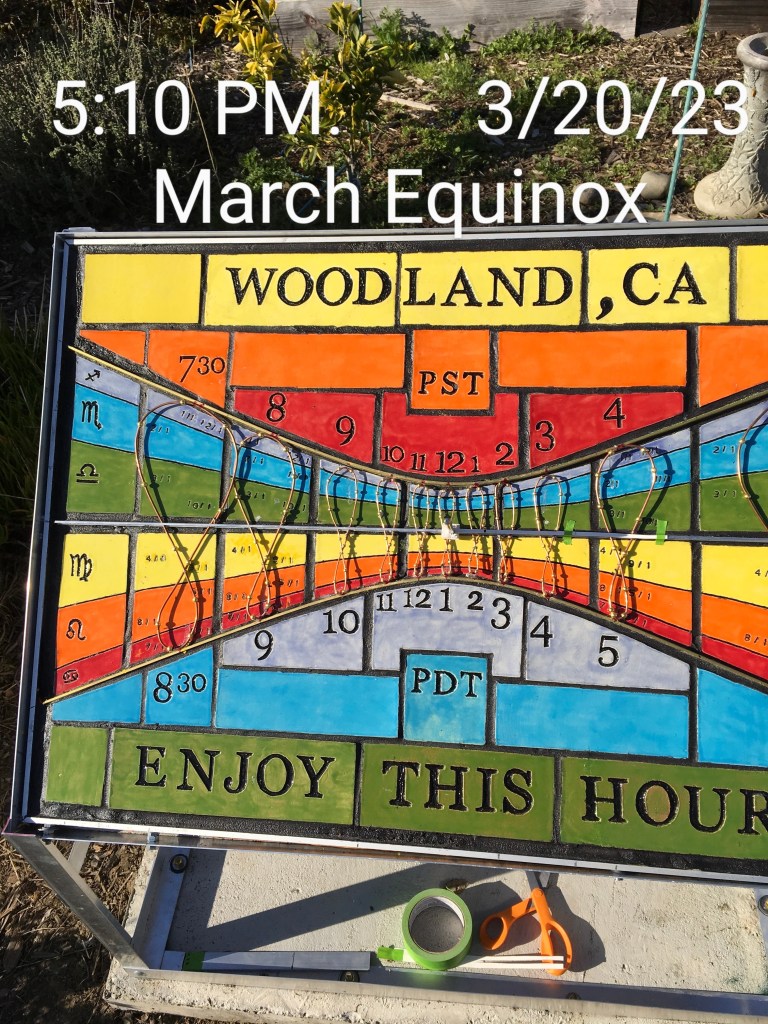
On 3/20/2023, the March Equinox, solar noon occurred at 1:14 PM, PDT. There should be no shadow:
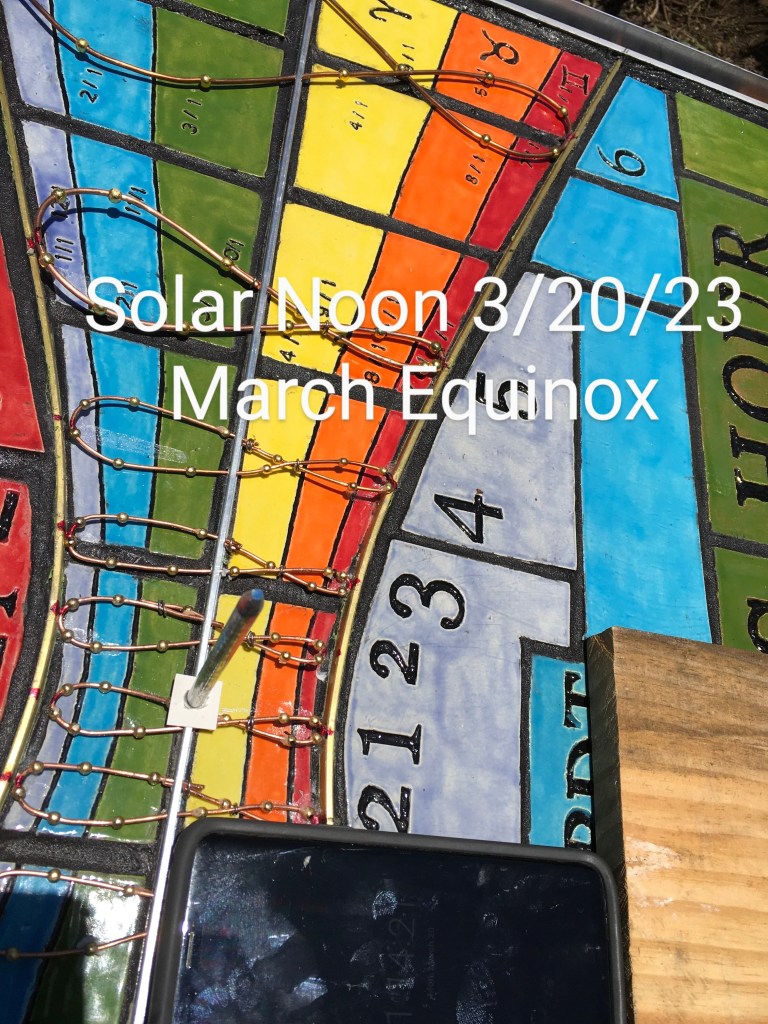
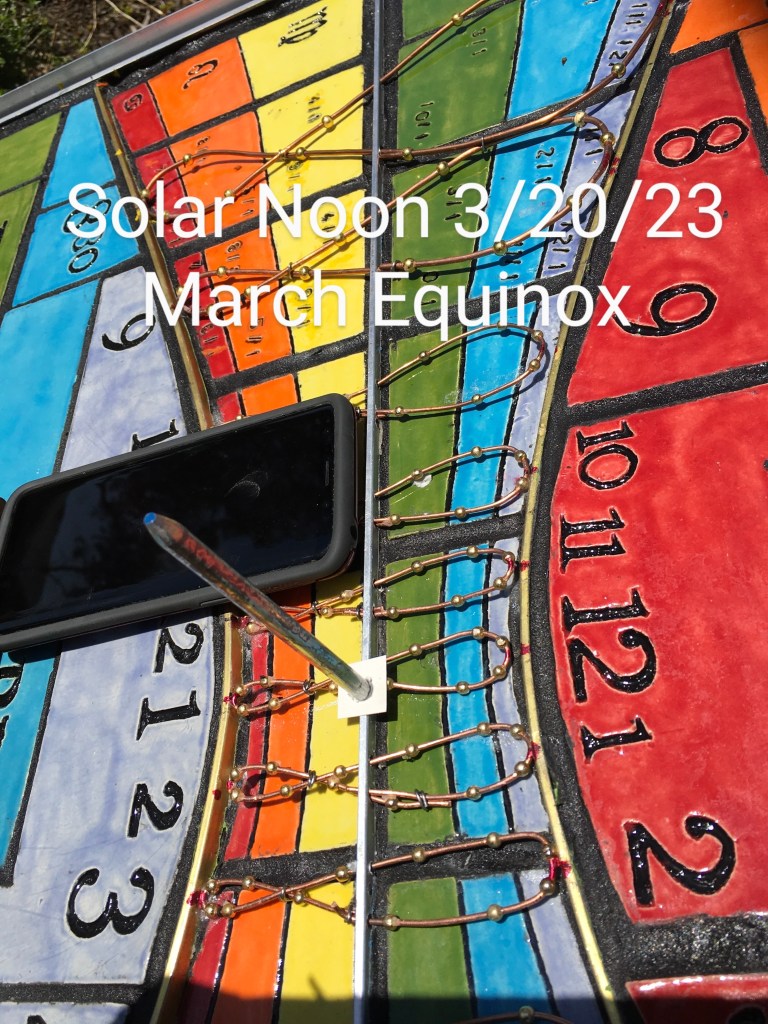
The keen-eyed will see there IS a tiny arc of shadow, on the north side, toward the red 12 ( noon, PST ). Since the exact Equinox occurs at 2:24 PM, just 76 minutes away, this is more than one might expect. The dial had been installed 3/18/2023, so it was still being tweaked. I took it down over the next week and raised the north side of the dial by 1/16 inch = 1.6 mm; after a few more days of observation, I raised it another 1.6 mm. The 5:10 PM photo also showed the shadow slightly north of the E-W Equinox line. Again, since the exact time of the Equinox was 2:24 PM PDT, at this time, the point of the gnomon should have been exactly on the east-west line. In the 5:10 photo above, the point is still north of the line, so the southeast corner of the dial was raised 1.6 mm.
I had to wait until the September Equinox, 9/22/2023, to see if these corrections woiud be enough. A time-lapse video can be seen on the Home Page by clicking the link under the photo, or on the Videos post : it looks good.
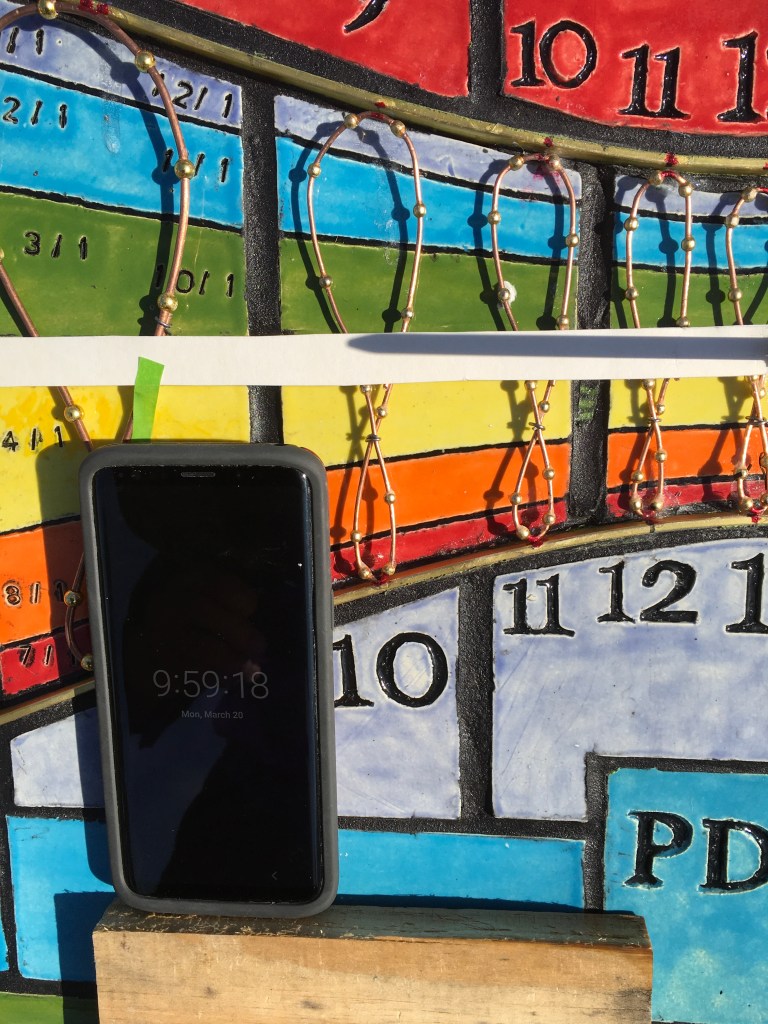
Since the Equinox aluminum bar is 3 mm above the tile surface, the shadow is foreshortened. I raised the gnomon 2mm just for the day on 3/20, and this showed the time, read on the left side of the figure-8 analemma, was accurate to the minute.
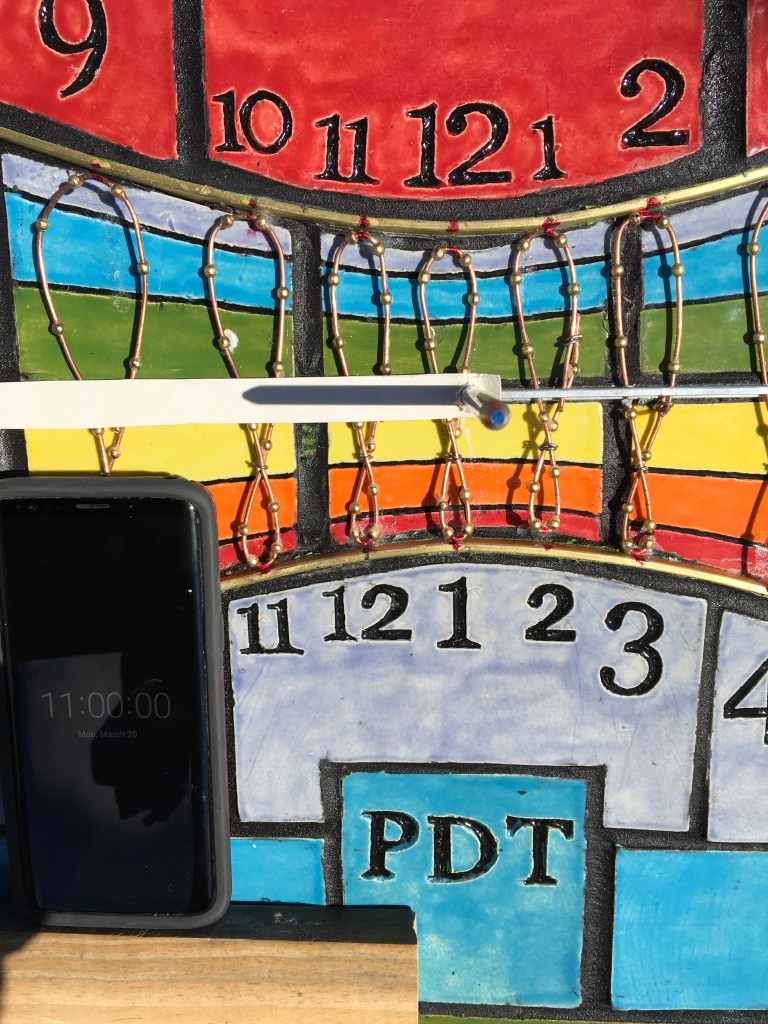
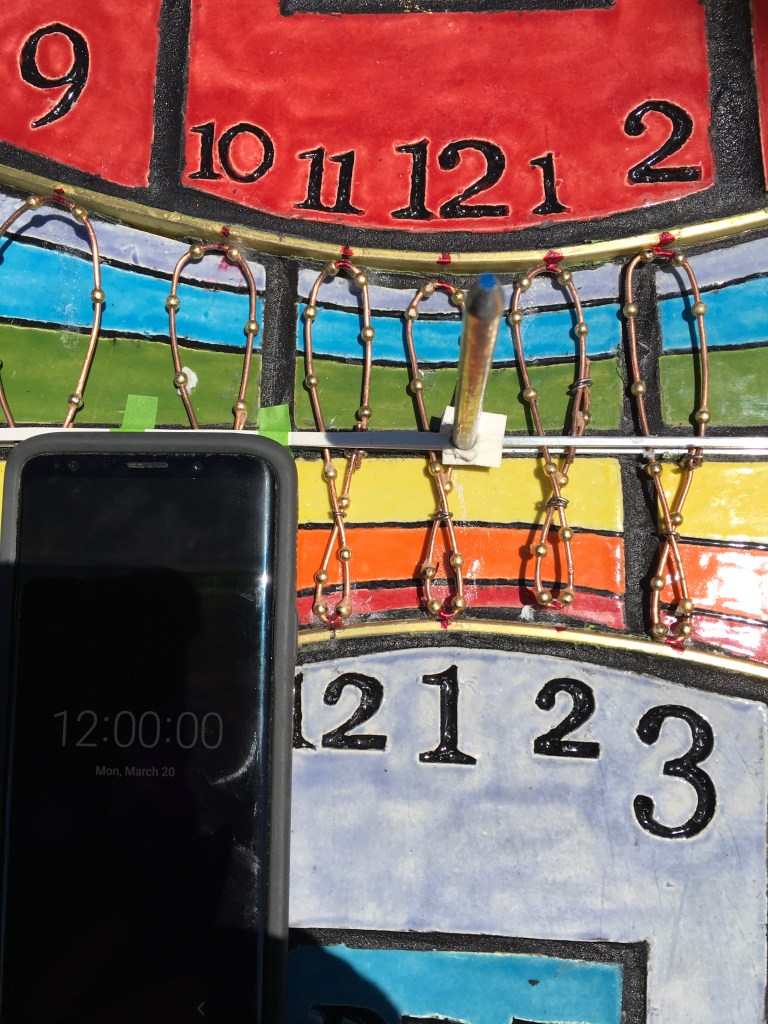
_________________________________________________________________________________
The next time the dial could be rigorously assessed was the March Equinox, March 19, 2024, with the Equinox coming at 8:06 PM PDT.
At sunrise on 3/19/24, the sun rose just south of the East-West line, since it is still Winter, and the shadow of then gnomon should be just north of the line.

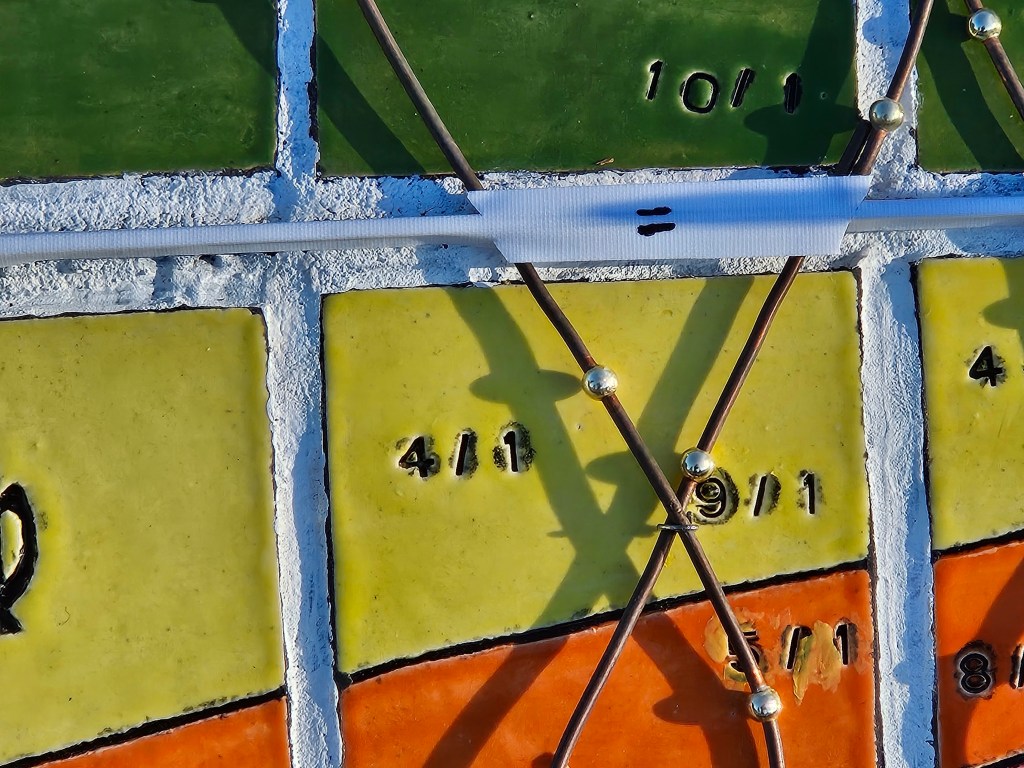
By 5:05 PM, the shadow is now closer to the midline, since Spring begins in 3 hrs, 1 min, when , if the sun were still shining, it should be exactly on the midline:
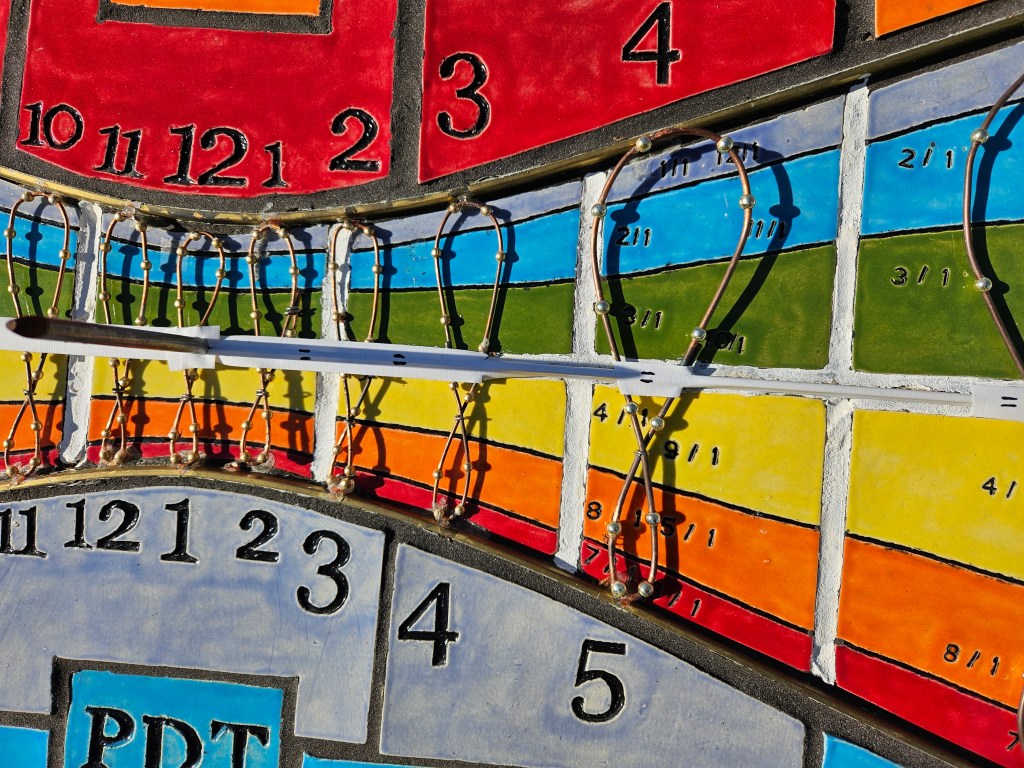
By 7:37 AM, on the following morning, 3/20, Spring has been around for almost 11 hours; the sun now rises north of the East-West line, and the shadow of the gnomon is now just south of the line :
At solar noon on 3/19/24, 1:14:42 PM PDT, the gnomon is pointing almost directly at the sun, and there should be almost no shadow:


There is a tiny arc of shadow on the north side. It is still just under 7 hours to the Equinox, so the sun still is slightly south of its Equinox position. By Solar Noon on the 20th, there was a tiny arc of shadow on the south side, since the sun is now north of its Equinox position. This is as good as it gets.
_________________________________________________________________________________
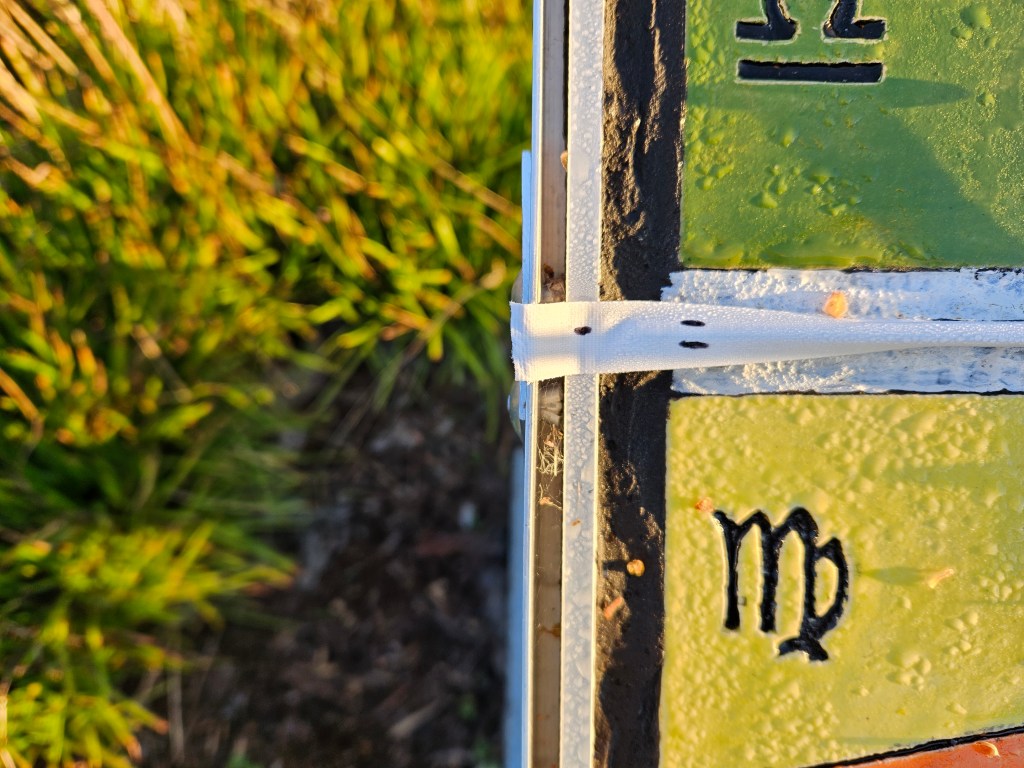
For fun, I thought I would see how closely the dial could measure the exact time of the Equinox. The East-West bar is 4 mm wide :

Using my dial calipers with a metric scale on the right side, I enlarged the photos so I could calibrate the bar to 4 mm :
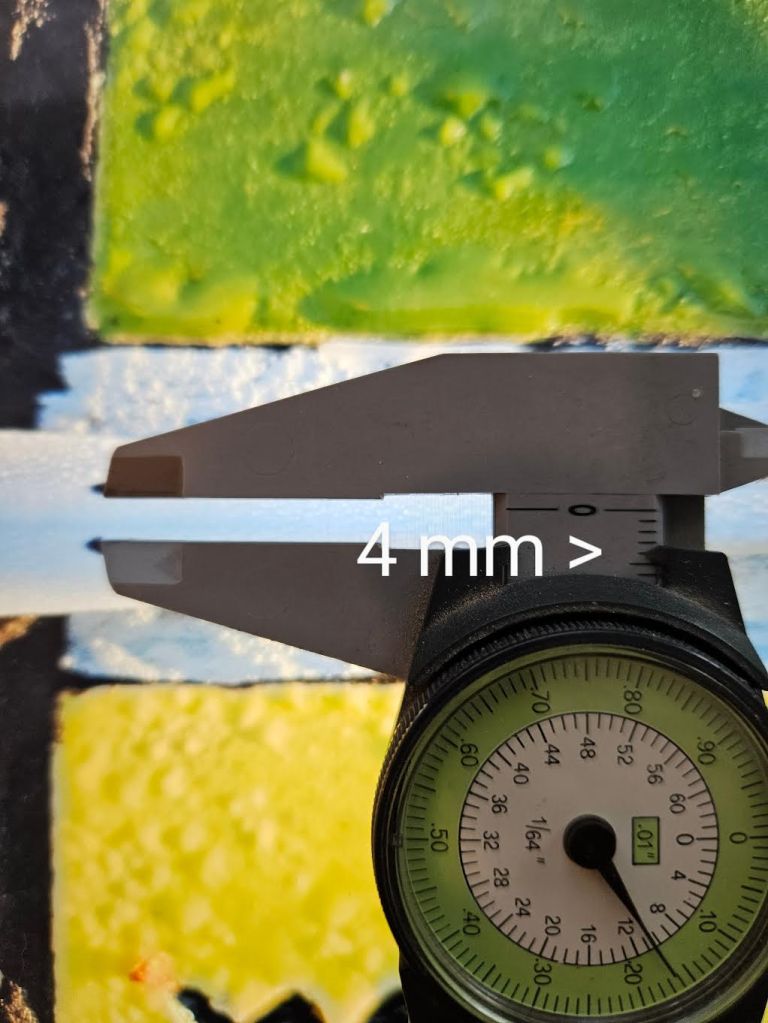
and then measured the gnomon shadow relative to the midline:

Making repeated similar measurements, I determined that the center of the shadow moved 5.5 mm from 3/19 7:47 AM to 3/20 7:37 AM: 5.5 mm/24 hr = 0.23 mm/hr. From 3/19 5:42 PM to 3/20 7:37 AM, the shadow moved 3.5 mm : 3.5 mm/14 hrs = 0.25 mm/hr. I measured the tip of the shadow on 3/19 5:42 PM to be 1 mm north of the midline:

Therefore, the gnomon tip had to travel 1 mm more to reach the midline, which would be the time of Equinox. At the determined speed of 0.25 mm/hr, it would take 4 hours. 5:42 PM + 4 hrs = 9:42 PM. Actual time, we know, was 8:06 PM. Even given all the potential errors in these measurements, (which I did not work backwards from !!), the dial seems accurate to within 4 hours. **
Happy Spring !!
_________________________________________________________________________________
*Since there may be an occasional viewer from Davis, CA, let me state that here and in other places on the site, it is assumed that the reader understands it is the apparent motion of the sun . The sun is stationary; it is the earth that moves.
** The math is more complicated than this, because the vertical distance traveled = the tangent of the angle of the gnomon times the horizontal distance to the gnomon, and the angle changes as it approaches zero on the Equinox. It is not linear, and depends on the distance to the gnomon. Still, the vertical motion from 7:30ish AM to the next day is valid since it is the same horizontal distance, averaging 0.23 mm/hr. The Equinox did occur overnight.
 Woodland Polar Sundial
Leave a comment